

You're halfway through the afternoon, your waistband feels tighter after lunch, and digestion is moving slowly enough to distract you during a meeting. You search for the best synbiotic supplements, hoping one capsule can address bloating, irregularity, and general gut imbalance without forcing you to decode a wall of marketing claims.
The practical answer is that the best formula isn't automatically the one with the most strains or the highest CFU number. A useful synbiotic should pair identified live microorganisms with a deliberately selected substrate, then show that the finished product remains potent and accurately labeled. The evidence supports targeted effects, but it doesn't justify treating every synbiotic as a universal microbiome repair product.
Table of Contents
- What a Synbiotic Actually Is and Why It Matters
- The Three Building Blocks of a Synbiotic
- What the Evidence Says Synbiotics Can and Cannot Do
- How to Compare Synbiotic Formulas Side by Side
- Reading a Synbiotic Label Like a Practitioner
- Matching Synbiotic Profiles to Real Reader Goals
- Why More Ingredients Are Not Always Better
- Smart Buying Checklist and Common Questions
What a Synbiotic Actually Is and Why It Matters
A synbiotic combines live probiotic microorganisms with a prebiotic substrate in one formulation. The probiotic supplies selected microbes, while the prebiotic supplies a fermentable material that host microorganisms can selectively use. The modern scientific framework grew from the 1995 definition of a probiotic and prebiotic mixture designed to improve the survival and implantation of beneficial microbes, as described in the synbiotic product market overview.
That distinction matters because a capsule containing bacteria and generic fiber isn't automatically a well-designed synbiotic. The substrate should have a reason for being there. Ideally, the manufacturer can explain why that fiber was paired with those specific strains and how the combination is expected to function.
A standalone probiotic introduces live microbes, but it doesn't necessarily provide their preferred fuel. A standalone prebiotic supplies fermentable fiber, but it doesn't add a defined microbial strain. A synbiotic attempts to coordinate both parts.
Practical rule: Treat “probiotic plus fiber” as a starting description, not proof of a scientifically matched formula.
The category has moved beyond a niche idea. One independent market report estimated the global synbiotic product market at USD 1.02 billion in 2024 and projected USD 1.11 billion in 2025, with a projected 8.3% CAGR from 2025 to 2030. The same market source estimated that dietary supplements represented 54.66% of synbiotic product revenue in 2025, making supplements the largest commercial segment within the category. Those figures describe market activity, not clinical effectiveness, so they shouldn't be confused with proof that synbiotics outperform probiotics for every symptom.
For buyers, the useful question is narrower: does the product contain a live microorganism component, a named substrate, and enough formulation transparency to judge whether the pairing makes sense? If the label only offers a proprietary blend and broad “gut health” language, it's difficult to evaluate the product as a true, purposeful synbiotic.
The Three Building Blocks of a Synbiotic
The ISAPP consensus defines a synbiotic as “a mixture comprising live microorganisms and substrate(s) selectively utilized by host microorganisms that confers a health benefit on the host”. It also separates complementary synbiotics, which combine independently functioning components, from synergistic synbiotics, where the substrate is selected for the included microorganism. The distinction is central to comparing formulations, not a minor technicality. Read the full ISAPP synbiotic consensus for the formal framework.
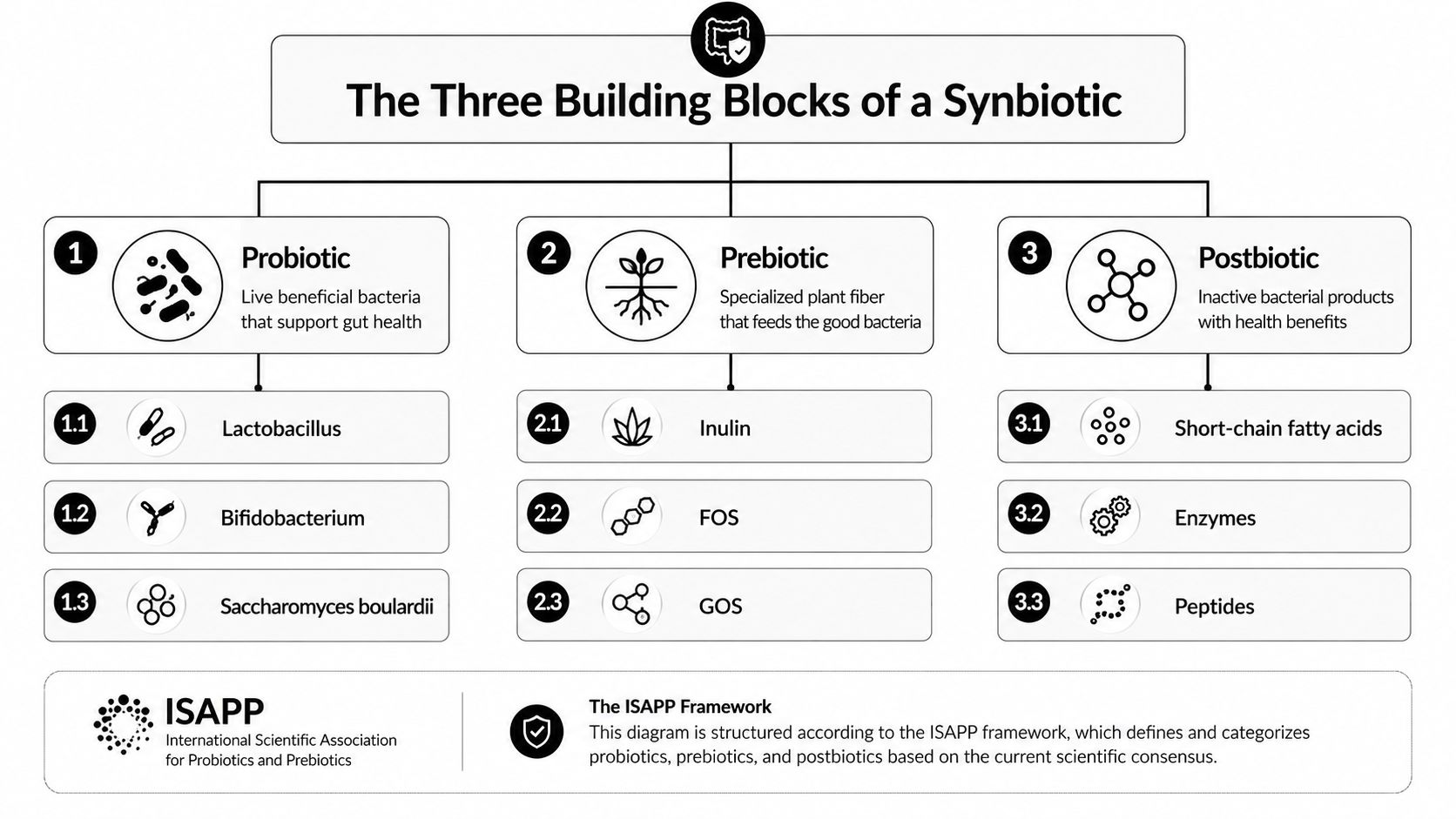
The live microorganism
The probiotic component should identify organisms at the genus, species, and strain level whenever possible. Lactobacillus and Bifidobacterium are common bacterial genera, while selected products may use the yeast Saccharomyces boulardii. A genus-species name alone still leaves important uncertainty because clinical effects can vary between strains within the same species.
The selective substrate
Prebiotics are fermentable fibers, but not every fiber is a prebiotic. Common synbiotic substrates include FOS, GOS, XOS, inulin, acacia fiber, partially hydrolyzed guar gum, and resistant starches. A 2015 review discusses FOS, GOS, XOS, inulin, and fructans as frequent partners in synbiotic formulations and describes their role in supporting probiotic viability in the gut. For practical help assessing fiber choices, see this guide to prebiotic fiber supplements.
The optional postbiotic layer
Postbiotics are not required for a product to qualify as a synbiotic. They may include inactivated microbial cells or microbial products such as enzymes, peptides, or short-chain fatty acids. Butyrate is often discussed because it participates in gut barrier biology, while the presence of a postbiotic ingredient doesn't prove that a particular product will reproduce every effect associated with the compound.
A complementary formula may combine a probiotic with a generally useful prebiotic. A synergistic formula makes a stronger matching argument, showing that the selected strain can use the included substrate. For example, GutRx BALANCE offers 30 billion CFUs per capsule with next-generation probiotics for gut health, digestive balance, and immune support. That product description identifies its intended category and use, but buyers still need label and testing documentation to judge strain-substrate fit.
What the Evidence Says Synbiotics Can and Cannot Do
A synbiotic may help with a defined biological target, but current evidence does not justify claims that every formula will restore the microbiome, eliminate bloating, or correct a complex digestive disorder. A review published in 2015 describes possible effects involving gut microbiota, intestinal epithelial integrity, immune regulation, short-chain fatty acid production, and barrier function. It also examines research involving inflammatory bowel disease, IBS, obesity, constipation, and antibiotic-associated diarrhea in the review indexed by PubMed.
That range of research reflects an active field rather than one established protocol. The practical implication is straightforward: match the formula to the goal. A product for general daily support should not be judged by an IBS trial, while a product intended for post-antibiotic diarrhea should not be selected only by its headline CFU count. Strain-substrate matching, viable CFUs through expiry, and independent testing often tell a buyer more than potency marketing.
What healthy-adult data suggests
A 2024 systematic review and meta-analysis in healthy adults reported a significant increase in Lactobacillus abundance and propionate concentration. The analysis did not find meaningful effects on zonulin, Shannon diversity, acetate, butyrate, IL-6, CRP, or endotoxin, as reported in the 2024 synbiotic meta-analysis.
That pattern has practical importance. Synbiotics may change selected microbes or microbial metabolites without broadly rebuilding microbial diversity or altering inflammatory biomarkers. Buyers should therefore expect a targeted biological effect, not a guaranteed whole-system reset.
IBS requires a cautious interpretation
IBS evidence remains mixed. A 2024 review identified only eight placebo-controlled randomized trials in adults, and its meta-analysis found no statistically significant overall symptom benefit because the studies differed substantially in their formulas, participants, and outcome measures. One randomized trial did report improvements in abdominal discomfort, bloating, formed-stool frequency, and fatigue with a high-dose combination containing Lactobacillus, Bifidobacterium, and fructooligosaccharides. The details appear in the IBS synbiotic evidence review.
The phrase “best synbiotic for IBS” therefore needs qualification. Strain identity, dose, substrate choice, baseline diet, and symptom pattern may matter more than the synbiotic label. Evidence is also limited for claims involving SIBO, candida overgrowth, mood disorders, and weight loss. Persistent diarrhea, bleeding, unexplained weight change, severe pain, and other warning signs require medical evaluation rather than self-treatment with a supplement.
How to Compare Synbiotic Formulas Side by Side
A useful comparison starts with clinical relevance, not the size of the front-label number. I'd give the greatest weight to strain specificity and evidence for the intended use, then examine whether the prebiotic makes biological sense, whether the CFU guarantee applies through expiration, and whether independent testing supports the label.
The five criteria below expose most weaknesses in synbiotic marketing:
- Strain selection depth: A full strain designation is more informative than a genus-only or species-only listing.
- CFU logic: A CFU guarantee through expiration is more useful than a number stated only at manufacture.
- Prebiotic fit: FOS, GOS, inulin, XOS, PHGG, and other fibers can behave differently, so the product should name the actual substrate.
- Delivery protection: Delayed-release or acid-resistant technology should be described clearly rather than used as an unsupported badge.
- Testing evidence: A third-party laboratory or accessible Certificate of Analysis should address identity, potency, and contamination status.
Synbiotic Formula Comparison Matrix
| Formula Type | Strain Specificity | CFU at Expiry | Prebiotic Fit | Delivery System | Third-Party Testing |
|---|---|---|---|---|---|
| Multi-strain high-CFU product | May list several species but omit strain codes | Often unclear unless explicitly guaranteed | May use a broad fiber blend | Could be standard or delayed-release | Look for a batch-specific COA |
| Single-strain targeted product | Usually clearer if the studied strain is named | Should be stated directly | Can be selected around the strain | Simpler delivery may be adequate | Verify identity and potency |
| Shelf-stable powder | Depends heavily on the label | Stability language requires close review | Fiber may be separate or blended | Packaging must control moisture and oxygen | Testing documentation is especially useful |
| Clinically studied formula | Names strains linked to the intended outcome | Stronger if guaranteed through expiry | Explains the substrate rationale | Technology should be documented | Trial and COA transparency are preferred |
A product such as GutRx's prebiotic and probiotic capsule guide can help readers understand the formulation distinction, but no educational page can substitute for checking the specific product label and batch documentation.
The best synbiotic supplements, in my view, are those that make the decision auditable. If a buyer can't identify the organisms, substrate, stability claim, and verification pathway, a high CFU count doesn't resolve the uncertainty.
Reading a Synbiotic Label Like a Practitioner
Start with the Supplement Facts panel, not the product name. Find the total serving size, then determine whether the CFU value is guaranteed at manufacture, through expiration, or not qualified at all. Those statements describe different levels of confidence, and a potency claim without a stability point is difficult to interpret.
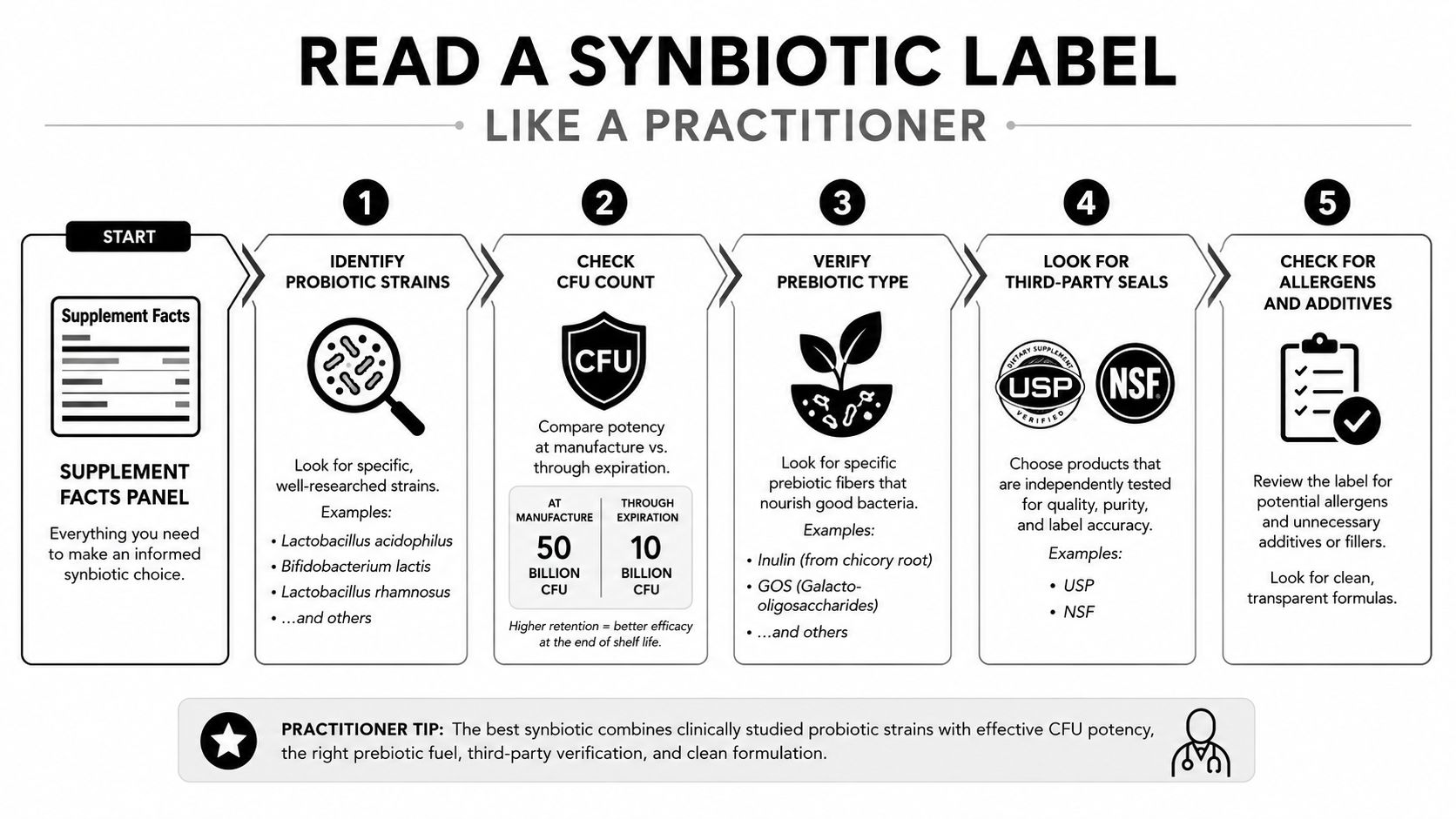
Identify the organism properly
A strong label provides genus, species, and an alphanumeric strain designation. Bifidobacterium animalis subsp. lactis HN019, for example, gives more useful information than “Bifidobacterium blend.” The strain code lets you compare the actual organism with published trials instead of assuming that every member of a species behaves identically.
Ambiguous wording deserves scrutiny. “Proprietary probiotic blend” may hide the amount of each organism, while “multiple strains” says nothing about whether the strains have been studied together.
Find the prebiotic and its amount
Look for a named fiber such as FOS, GOS, inulin, XOS, acacia, or PHGG. If the formula includes a prebiotic blend but doesn't disclose the individual ingredients or amounts, you can't assess whether the substrate is likely to be gentle, highly fermentable, or appropriate for someone sensitive to FODMAPs.
Then check the delivery claim. “Acid-resistant” should connect to an actual capsule or release technology, not stand alone as packaging language. Storage instructions also matter because heat, humidity, and oxygen can affect viability, particularly in powders and products that require refrigeration.
Verify the batch
Third-party testing is intended to confirm strain identity, CFU count, and contamination status. Best practice is testing through an ISO/IEC 17025-accredited laboratory, as explained in this resource on probiotic quality testing and verification. Look for a batch-specific COA, the testing date, the laboratory identity, and assays that correspond to the finished product.
GutRx's explanation of what a Certificate of Analysis contains is useful for understanding the document. Also review allergens, capsule materials, excipients, and storage instructions. Those details can determine whether a formula fits your diet and routine, even when they don't affect the headline marketing claim.
Matching Synbiotic Profiles to Real Reader Goals
A daily maintenance buyer, a person with IBS-style bloating, someone recovering after antibiotics, and a woman seeking gut plus vaginal support shouldn't automatically choose the same formula. The structure should reflect the goal, the person's tolerance for fermentable fibers, and the strength of strain-specific evidence.
The daily maintenance user
Someone seeking everyday regularity may prefer a moderate-diversity blend with a gentle substrate such as PHGG. The essential features are clear strain identities, a labeled prebiotic amount, and a potency guarantee through expiration. A large formula isn't necessary if the buyer can't tolerate its fiber load.
The bloating and IBS-style reader
A reader whose primary complaint is bloating may need a more conservative prebiotic strategy. Highly fermentable fibers can aggravate gas for some people, so a lower-FODMAP approach and gradual introduction may be more practical than choosing the broadest fiber blend. A strain such as Bifidobacterium infantis 35624 is worth investigating only when that exact strain is present and the product's intended use aligns with the available evidence.
The post-antibiotic user
After antibiotics, a buyer may look for Saccharomyces boulardii alongside a targeted Bifidobacterium combination. The label should identify the yeast or bacterial strains, provide clear dosing information, and explain storage and stability. Persistent or severe diarrhea needs medical assessment, particularly if dehydration or other warning signs develop.
The woman seeking combined support
For a woman interested in digestive and vaginal support, strain-level transparency is essential. Lactobacillus rhamnosus GR-1 and Lactobacillus reuteri RC-14 are the names to look for when a product makes a strain-specific urogenital evidence claim. Cranberry or D-mannose may appeal to buyers searching for urinary support, but those ingredients don't make an unspecified probiotic blend equivalent to a strain-documented formula.
The practical pattern is simple. Choose the target first, then choose the microbes and substrate, rather than starting with the largest bottle or the most elaborate product title.
Why More Ingredients Are Not Always Better
A 20-strain formula with 100 billion CFUs sounds more powerful than a focused three-strain product, but the label doesn't establish that conclusion. More organisms can create a more complicated ecological environment, and the finished product may provide too little information about which strain receives which substrate or whether the combination has been studied as a whole.
The evidence supports a narrower interpretation of potency. In healthy adults, the meta-analysis cited earlier found a targeted increase in Lactobacillus abundance and propionate, but not a broad improvement across every measured microbiome and inflammatory marker. That result argues for specific biological effects, not an automatic advantage for maximal ingredient counts.
A sprawling proprietary blend can also inflate cost without giving the buyer a way to judge dose, viability, or clinical relevance. Competitive interactions between organisms are possible, but the more important consumer problem is usually simpler: the formula becomes impossible to audit.
A shorter label with verified strain identifiers and a recent COA can be more persuasive than a long panel with no individual amounts.
The highest-value synbiotic is the one with a defensible connection between strain, dose, substrate, delivery, and intended outcome. That may be a focused blend, a single-strain product with a carefully selected fiber, or a broader formula if the manufacturer discloses why the components belong together. Ingredient quantity is only useful when the formulation explains what each ingredient contributes.
Smart Buying Checklist and Common Questions
Before ordering one of the best synbiotic supplements, make the purchase itself part of the evaluation. Confirm the product is available through a seller with clear storage and shipping practices, especially during warm weather. Review the return policy and guarantee before opening the container. A refund option cannot correct a weak formula, but it limits the cost of testing a product that does not suit you.
Set a 2–4 week trial window before judging digestive changes, unless the label or a clinician recommends otherwise. Track one or two outcomes, such as stool regularity or meal-related bloating. Avoid changing several supplements at once, or you will have little basis for deciding what helped or caused discomfort.
Should you take a synbiotic with food? Follow the product instructions. Timing can depend on the strain, capsule design, and substrate, so a general empty-stomach rule should not override the label.
How much should you take? The amount varies by strain and purpose. A general-use product may differ from a clinician-directed protocol. A higher CFU count does not replace an appropriate organism, substrate, and tolerability.
Can everyone take one? People who are immunocompromised, seriously ill, pregnant, or managing complex medical conditions should consult a qualified healthcare professional before starting a probiotic or synbiotic. Stop and seek medical advice if symptoms are severe, persistent, or unusual.
Does it need refrigeration? Some products are shelf-stable, while others require refrigeration. Follow the storage statement exactly. Poor storage can reduce viability despite an impressive label.
When should you notice a change? Digestive responses vary, and immediate global improvement is an unrealistic benchmark. If discomfort worsens, reassess the product and arrange a clinician conversation, particularly when symptoms persist or the intended outcome remains unclear.
GutRx offers targeted synbiotic and probiotic options for specific digestive-support goals, including GutRx products with strain-focused formulations and downloadable Certificates of Analysis. Review the relevant formula, label details, and testing information before deciding whether it fits your trial plan.


