

Akkermansia muciniphila probiotic products get talked about like they're a universal fix for bloating, IBS, and everyday gut discomfort. They're not. The strongest evidence for this strain points more clearly toward gut-barrier support and metabolic markers than toward fast, reliable relief of digestive symptoms, so the question isn't whether Akkermansia is interesting, it's whether it matches your actual goal.
That distinction matters because Akkermansia muciniphila is not a standard shelf-stable Lactobacillus or Bifidobacterium blend. It's a next-generation probiotic first isolated from human feces in 2004, and that recent history explains both the excitement and the uncertainty around it (PMC review on Akkermansia). If you're deciding whether to buy one, the right lens is simple, what does it do well, what does it not do well, and who should be cautious.
Table of Contents
- Why Akkermansia Muciniphila Is Not a Typical Probiotic
- How Akkermansia Works Inside the Gut Barrier
- Clinical Evidence for Metabolic vs. Digestive Outcomes
- Live Versus Pasteurized Akkermansia Supplements
- How to Evaluate Akkermansia Product Quality
- Supporting Akkermansia with Prebiotics and Synbiotics
- Who Should Consider Akkermansia and Who Should Wait
Why Akkermansia Muciniphila Is Not a Typical Probiotic
Probiotic shopping often treats the category as one thing. It isn't. Akkermansia muciniphila behaves differently from the familiar strains found in many daily probiotic products, and that difference changes how you judge it as a supplement.
A different organism, a different job
Akkermansia is a strictly anaerobic, Gram-negative, mucin-degrading bacterium that uses mucin as its sole carbon, nitrogen, and energy source (PMC strain biology review). That means it lives in the intestinal mucus layer, not as a generic traveler in the gut lumen. In healthy adults, it commonly makes up about 1% to 4% of the gut microbiota, and some reviews put the range at roughly 0.5% to 5%, which is unusually prominent for a single species in a healthy ecosystem (PMC review, IPA Biotics overview).
That biology matters because the market often sells Akkermansia like a broad digestive comfort probiotic. The evidence doesn't support that leap yet. The strain is better understood as a barrier-support organism, and the NCI describes an oral Akkermansia probiotic as having potential immunomodulating and mucosal-protective activity (NCI dictionary entry).
Practical rule: If your main goal is symptom relief for bloating or irregularity, Akkermansia is not the first strain I'd reach for. If your goal is barrier support and metabolic monitoring, it deserves a closer look.
Why the 2004 isolation matters
Akkermansia was first isolated in 2004, which makes it a relatively new entrant in probiotic development (PMC review). That's one reason you'll see less certainty around everyday digestive outcomes than you'll see around older strains with decades of consumer use.
Its abundance also appears early in life. Reviews note that it can become detectable in infants soon after birth and stabilize in the human gut within about 1 year after birth, reaching adult-like levels (PMC review). That's a clue that it's not a passing visitor. It's part of the gut ecosystem itself.
For buyers, the takeaway is straightforward. Akkermansia belongs in the decision-stage category, not the “just take it because it's trendy” category. If you're comparing products, start with the question GutRx uses in its own educational material, what kind of probiotic strain are you trying to add, and for what purpose? Their overview of next-generation probiotics frames that shift well in the context of modern gut support, next-generation probiotic education.
How Akkermansia Works Inside the Gut Barrier

Akkermansia earns its reputation because it works where the gut lining is built and maintained. It doesn't act like a random occupant. It acts like a mucus-layer gardener, using the mucus itself while helping the barrier stay functional.
Mucin-degradation and barrier turnover
Because Akkermansia feeds on mucin, it is linked to mucus-layer turnover and host barrier maintenance (PMC strain biology review). That's the core of its appeal. A healthier mucus layer can help the intestine maintain separation between the gut environment and the rest of the body, which is why researchers often discuss Akkermansia in the context of intestinal permeability and barrier resilience.
Its outer-membrane protein Amuc_1100 has also been identified as an immunomodulatory effector associated with improved metabolic and inflammatory signaling in preclinical and review data (ScienceDirect topic page). That matters because not all probiotic effects come from live replication alone. Some effects can be tied to structural components that interact with the immune system.
The cleanest way to think about Akkermansia is this. It's less about crowding out pathogens in the usual probiotic sense, and more about helping the mucus barrier stay dynamic.
Why its ecology is unusual
Akkermansia's habitat is the intestinal mucous layer, which is very different from the bacteria many people already know from marketing labels. It is also abundant early in life, then becomes a stable resident rather than a transient supplement ingredient (PMC review). That early colonization helps explain why researchers describe it as a core mucus-associated commensal.
A useful clinical takeaway is that Akkermansia's biology aligns more naturally with barrier maintenance than with immediate symptom masking. That's one reason a person can be interested in it even if they're not chasing a quick “less gas by Friday” result.
For readers also comparing barrier-focused products, the concept of intestinal permeability is discussed in more detail in this GutRx overview on intestinal permeability, which fits this biology better than a generic digestive wellness lens.
Clinical Evidence for Metabolic vs. Digestive Outcomes
The human data on Akkermansia are real, but the most convincing results sit in a narrower lane than many supplement pages suggest. The strongest signal is metabolic, while everyday digestive symptom relief remains much less certain. That difference matters if you are trying to choose a product for a specific goal rather than buying into a broad probiotic promise.
Stronger evidence for metabolic outcomes
The clearest human signal comes from a 3-month randomized clinical study in overweight and obese adults. In that study, pasteurized A. muciniphila improved insulin sensitivity by 28.62% ± 7.02% versus placebo and reduced insulinemia by 34.08% ± 7.12% (The Akkermansia Company resources). The same study also reported that plasma total cholesterol fell by 8.68% ± 2.38%, while body weight trended down by 2.27 ± 0.92 kg, fat mass by 1.37 ± 0.82 kg, and hip circumference by 2.63 ± 1.14 cm, although not all body-composition changes reached conventional significance.
Those are quantitative human endpoints, which puts this strain in a different category from products that rely mainly on lab models or general gut-health claims. It also explains why Akkermansia keeps appearing in discussions of obesity, type 2 diabetes, and cardiometabolic support.
Much thinner evidence for everyday digestive symptoms
The part buyers need to hear clearly is that evidence for bloating, IBS, constipation, and diarrhea support is much thinner. Recent reviews still frame Akkermansia mainly as a next-generation probiotic for obesity, type 2 diabetes, cardiovascular disease, and immune modulation, while everyday symptom relief remains less directly studied and less convincing for many promoted uses (PubMed review on digestive symptom gaps).
That does not mean it cannot help some people. It means the current data do not justify treating it like a reliable fix for loose stool, slow transit, or post-meal discomfort. The consumer story is often broader than the evidence.
Clinical rule of thumb: If your main question is “Will this help my lab markers or barrier support?”, Akkermansia is reasonable to evaluate. If your main question is “Will this stop my bloating next week?”, the evidence is still too thin to promise that.
A note on inflammatory gut disease
There is also a caution point that gets glossed over in marketing. Some critical reviews note that boosting Akkermansia could be counterproductive in certain inflammatory gut settings, including IBD, and that live versus pasteurized forms may behave differently (PMC critical review). That does not mean the strain is unsafe across the board. It means context matters, and gut history matters even more.
| Outcome Area | Evidence Strength | Key Findings |
|---|---|---|
| Metabolic markers | Stronger | Human trial data show improved insulin sensitivity, reduced insulinemia, and lower total cholesterol with pasteurized Akkermansia (The Akkermansia Company resources) |
| Barrier support | Moderate | Mechanistic data link mucin-degradation and Amuc_1100 to barrier maintenance and immune signaling (ScienceDirect topic page) |
| Everyday GI symptoms | Limited | Reviews still describe symptom-relief evidence as thinner and less direct (PubMed review on digestive symptom gaps) |
| IBD or active inflammation | Caution needed | Critical reviews raise the possibility of counterproductive effects in some inflammatory contexts (PMC critical review) |
Live Versus Pasteurized Akkermansia Supplements
This choice affects what the supplement can realistically do. Live and pasteurized Akkermansia are not interchangeable, and the right format depends on whether you care more about delivery of a living organism or about the metabolic signal that has already been studied in humans.
Why pasteurized products entered the evidence base first
The best-known human metabolic trial used pasteurized Akkermansia, not live Akkermansia. That detail matters because buyers often assume “live” is automatically the stronger option. With Akkermansia, the evidence base developed in a different order, and the format with human data is not the format people usually expect.
Pasteurization also solves a practical problem. Akkermansia is an obligate anaerobe, so keeping it alive in a supplement is technically difficult. In a market full of fragile claims, that is a real formulation challenge. The fact that some benefits were shown with pasteurized material means the product does not have to be alive at the moment of use to have biological relevance.
Safety and survival are not the same question
Safety data have moved forward in a meaningful way. A 90-day toxicology study found no test-item-related adverse effects and identified 1500 mg/kg body weight/day as the no-observed-adverse-effect level, equivalent to 9.6 × 10^10 A. muciniphila cells/kg body weight/day. Independent summaries also report that both live and pasteurized A. muciniphila at 10 billion CFU daily for 3 months have been reported as safe in humans.
That said, the strain itself still matters. The Akk11 safety evaluation found 98.36% genomic similarity to the type strain, with no mobile elements, no harmful metabolites, no Caco-2 cytotoxicity, and no adverse findings in acute, mutagenicity, micronucleus, and 90-day studies, with a reported NOAEL of 9 × 10^11 AFU/kg/day. That is the kind of strain-specific evidence buyers should look for, because safety is increasingly a strain-level question, not a species-level assumption.
Bottom line: Live Akkermansia makes sense only if the product can truly protect and deliver an anaerobic organism. Pasteurized Akkermansia is easier to justify when the goal is a tested format with human metabolic data behind it.
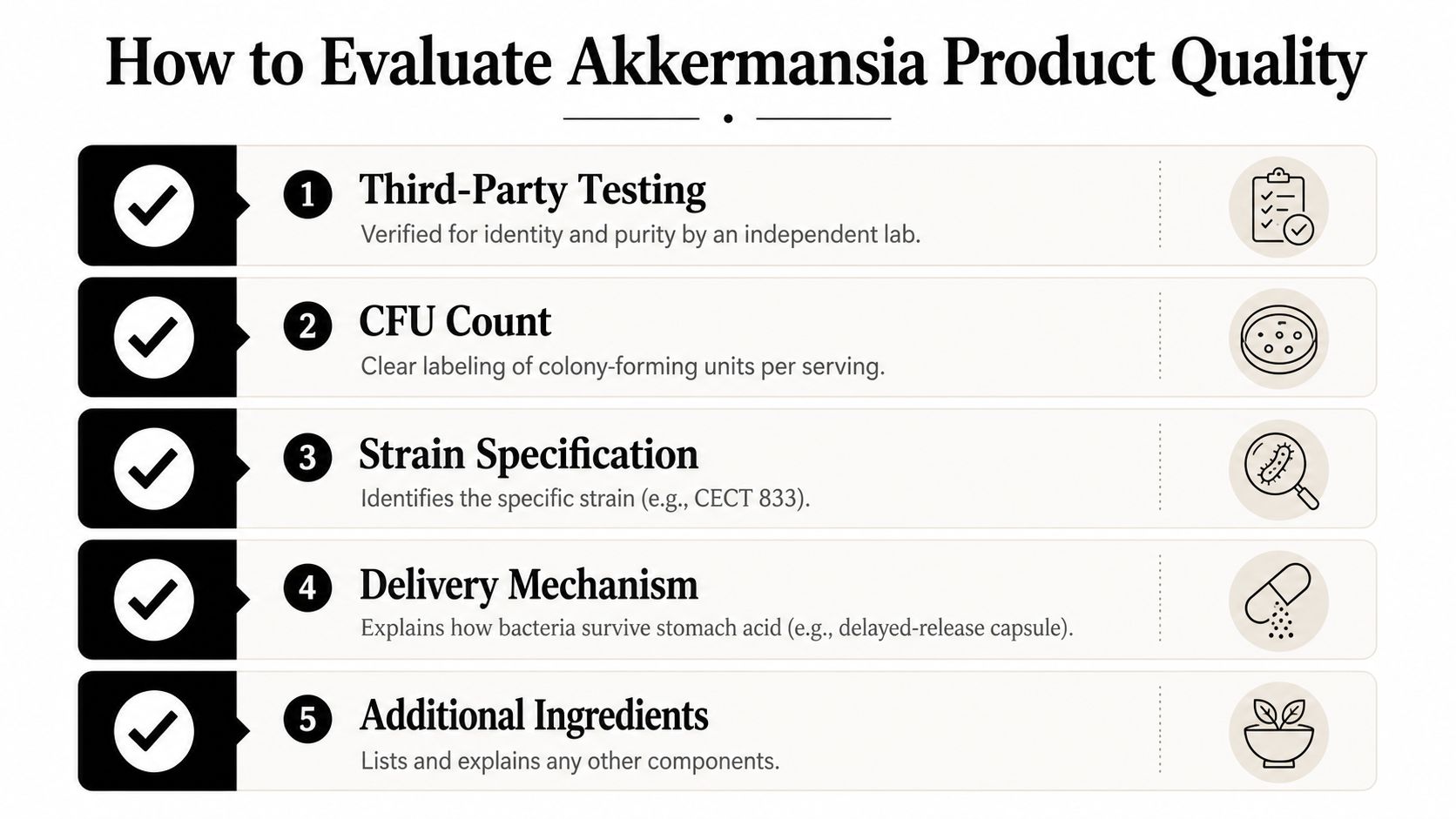
For people comparing formulas, a delayed-release or otherwise protective delivery system matters because an anaerobic organism has a harder job surviving the upper GI tract. If you are sorting through labels, a broader product-quality filter helps, including third-party tested probiotics.
How to Evaluate Akkermansia Product Quality
Akkermansia is not a casual add-to-cart ingredient. The category is still new enough that strain verification, testing transparency, and delivery details matter more than front-of-box claims, especially if your goal is metabolic support rather than assuming you'll get reliable everyday digestive relief from any bottle on the shelf.
What belongs on the label
Start with third-party testing. If a brand cannot show independent identity and purity checks, you are taking a real risk in a category where manufacturing quality can vary. Downloadable Certificates of Analysis are especially useful because they let you verify what is in the bottle, not just what the label promises. A practical place to start is a third-party tested probiotics checklist that shows which verification steps a serious brand should be able to document.
The next requirement is strain-level specificity. A serious product should identify the strain, not just list “Akkermansia” in generic terms. That matters because safety and performance are evaluated at the strain level, and buyers should expect a company to show that level of characterization before they trust a next-generation probiotic.
What helps the organism survive the trip
Akkermansia is a difficult ingredient to formulate. It is an anaerobe, so packaging and delivery method matter. Buyers should look for acid-resistant or time-delayed release capsules, clear storage instructions, and a serving statement that distinguishes CFU at manufacture from what is expected at expiration. Those are practical details, not marketing fluff.
Formulation context matters too. If a product includes prebiotics or postbiotics, that can be useful, but only if the label explains the reason clearly. A transparent formula tells you whether you are buying a stand-alone Akkermansia product or a broader ecosystem supplement.
For GutRx specifically, the relevant benchmark is its public quality approach, which emphasizes downloadable COAs, third-party testing, and strain-focused positioning in its probiotic line. That is the kind of documentation I would want any next-generation probiotic to provide before I recommended it to a patient.
A solid label should also tell you whether the product is vegan, non-GMO, gluten-free, and made in the USA if those standards matter to you. None of those alone prove efficacy, but together they show whether a brand is treating a next-generation strain like a serious formulation or a buzzword.
Supporting Akkermansia with Prebiotics and Synbiotics
Akkermansia doesn't live in isolation, and neither should you think about it. The smarter approach is often ecosystem support, not just a single capsule.
Why the surrounding environment matters
Because Akkermansia feeds on mucin, it doesn't depend on the same fuel pattern as a standard prebiotic-only product. That's one reason a simple fiber blend isn't always enough to support the strain in a meaningful way. Some observational and preclinical work has linked polyphenol-rich foods and certain prebiotic fibers, including inulin and polydextrose, with increased Akkermansia abundance, but that doesn't turn them into a universal prescription.
The practical takeaway is that if you're trying to support Akkermansia, the broader diet matters. Foods like berries, green tea, beans, oats, onions, leeks, apples, nuts, and flaxseed are often used in that kind of support pattern because they contribute polyphenols or fermentable substrates. That's supportive, not magical.
Why synbiotics are the more interesting strategy
A synbiotic combines probiotics, prebiotics, and sometimes postbiotics in one formula. For next-generation strains, that can make more sense than throwing Akkermansia into a standalone capsule and hoping the gut environment cooperates. The point is ecosystem alignment, not ingredient maximalism.
That's where broader formulas can fit. GutRx's Complete concept is positioned around probiotic plus prebiotic plus postbiotic support, which is the right idea when the goal is microbial balance rather than a single-strain experiment. A formula like that can make sense for people who want more than one mechanism covered at once.
A supplement strategy works better when the ingredients support one another. Isolating a single strain can be fine for targeted use, but it's often less practical than building around the ecosystem it needs.
If you're already using a daily probiotic, the main question is whether Akkermansia should be layered in as part of a broader routine or reserved for a more specific objective, such as barrier support or metabolic goals.
Who Should Consider Akkermansia and Who Should Wait
Akkermansia makes the most sense when a person's goal matches what the strain has been studied for. That sounds plain, but it is where a lot of supplement decisions go wrong.
Adults focused on metabolic health markers and gut-barrier support are the clearest fit for the current evidence. If the main goal is insulin sensitivity, cholesterol, or barrier resilience, Akkermansia is a reasonable strain to consider, especially in a product with clear strain identification and quality control. People dealing with IBS, bloating, or irregularity can still consider it, but they should be realistic. The symptom-relief evidence is thinner than the metabolic story, and that gap matters if the goal is day-to-day digestive comfort.
Some women looking for a combined gut and metabolic strategy may also fit this profile, especially if they already use a broader synbiotic routine rather than a single-purpose product. The fit is more selective for people with active inflammatory bowel disease, complex GI histories, or a strong sensitivity pattern. In those cases, recent critical review work and broader inflammatory gut guidance support a clinician conversation first, because the evidence base is not straightforward in inflammatory contexts. That caution is also reflected in the PMC critical review and in inflammatory bowel disease discussions that treat this strain as something to assess carefully rather than assume is harmless for everyone.

The practical takeaway is simple. Akkermansia is more clearly a metabolic and barrier-support probiotic than a symptom-relief probiotic. That does not make it less useful. It makes it more specific, and specificity is what should guide the decision.
If you want a formula built around that kind of specificity, GutRx offers strain-focused probiotic and synbiotic options with transparent testing and category-based support. Visit GutRx to compare the current formulas, read the product details, and decide whether Akkermansia belongs in your own gut-health plan.


