

Do probiotics survive stomach acid? Some strains do, but survival varies widely enough that a yes-or-no answer is almost meaningless on its own. The strain, dose, meal timing and delivery format all influence what reaches the intestine.
The sharper question is what a survival claim measured. A strain can stay viable in simulated gastric fluid, a dose can deliver live cells to the intestine, or a finished product can show a benefit in people. Those are three separate findings, and the first does not establish the second or third. A label is most informative when it names the strain, dose, test conditions and stage of digestion its evidence covers.
Table of Contents
- What Happens to Probiotics in the Stomach
- Survival Numbers From Stomach Acid Tests
- Why Some Strains Survive and Others Do Not
- Delivery Formats and What Lab Tests Can Prove
- How to Check a Label for Survival Evidence
- Choose a Probiotic Built for Gut Delivery
- Frequently Asked Questions
What Happens to Probiotics in the Stomach
Follow one capsule and the reason survival is conditional becomes obvious, because the setting changes at every step.
Swallowed on an empty stomach at 7 a.m., it lands in fluid at roughly pH 1.5, close to the floor of what bacteria tolerate; taken with breakfast, the same capsule meets a far gentler bath nearer pH 3.0 to 5.0 (gastric survival and the FAO/WHO framework). The stomach also secretes a continuous flow of gastric juice, a mix of hydrochloric acid and pepsin that breaks down protein and, incidentally, bacterial cell membranes. Acid that penetrates a cell drops its internal pH and disrupts the enzymes it uses to make energy.
The clock matters as much as the pH
Gastric emptying sets exposure time, and the window runs from about five minutes to two hours depending on what else is in the stomach (review of probiotic gastrointestinal transit). Cells that cope with the wait often lean on proton pumps such as F1Fo-ATPase to hold their internal pH while the outside turns hostile. A capsule dropped into a near-empty stomach can be gone before much damage is done. The same capsule buried in a heavy meal sits in acid long enough for the arithmetic to turn against it.
Practical rule: the CFU figure on a label describes what left the factory. Only strain-specific acid testing describes what has a chance of reaching the small intestine.
That timing trade-off is why meal instructions on a probiotic aren't decorative. Buffering acid with food and shortening exposure on an empty stomach are both legitimate strategies, and which one wins depends on the strain and the coating. Our guide to when is the best time to take probiotics works through the choice.
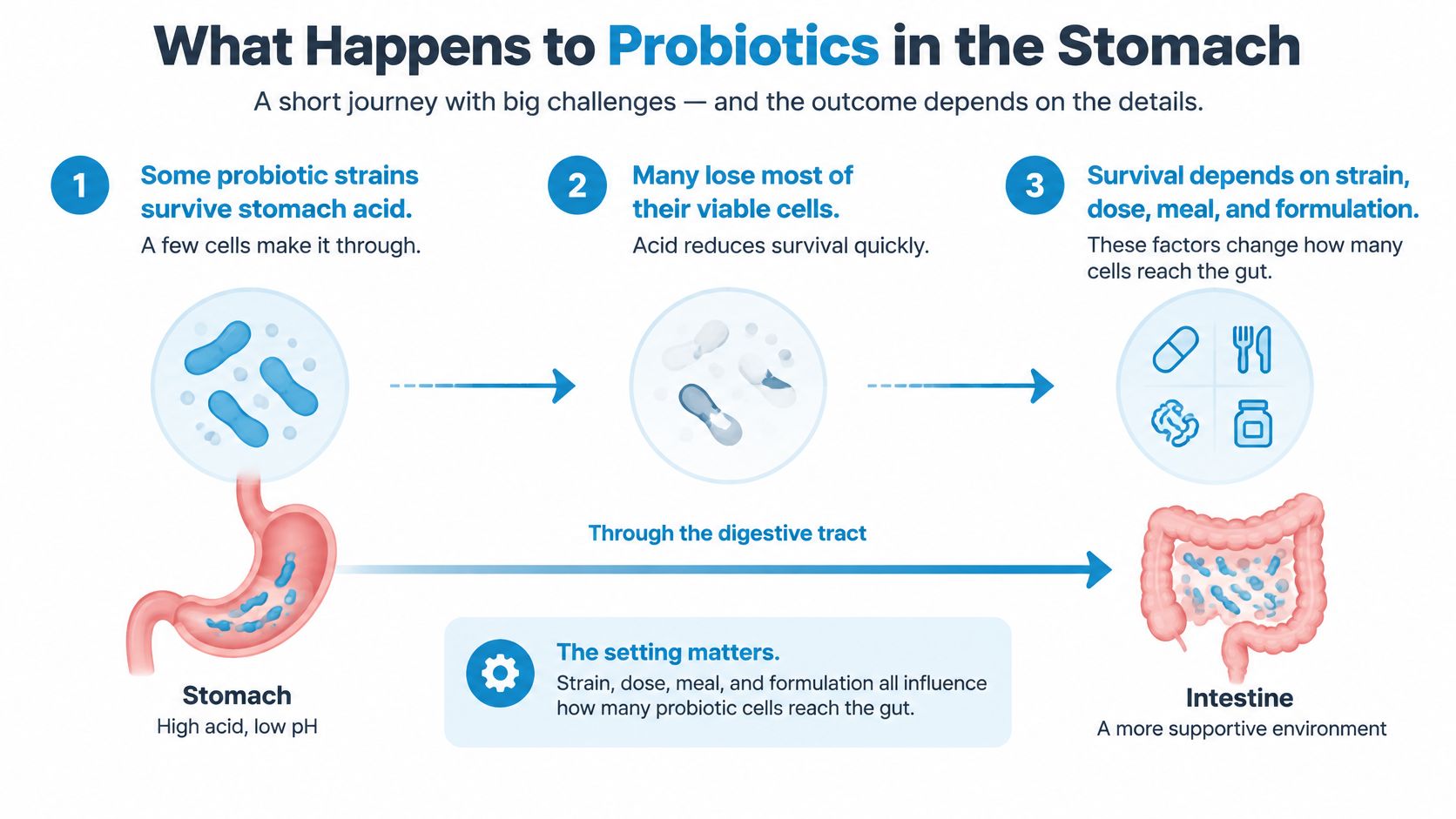
Intrinsic acid resistance is uncommon among probiotic organisms. The groups that handle it best include Lactobacillus acidophilus and the bifidobacteria, which is part of why those names appear in so many formulas. The 2001 FAO/WHO expert consultation turned that observation into a quality standard, making resistance to gastric juice and subsequent growth in bile core criteria for evaluating a probiotic rather than optional extras. Worth carrying into the next aisle: tolerating a gastric simulation is a laboratory property, a benefit in people is a clinical claim, and the first does not prove the second.
Survival Numbers From Stomach Acid Tests
Reported survival in simulated stomach-acid tests
| Strain or formulation | Test condition | Reported result |
|---|---|---|
| Lactiplantibacillus plantarum 299v | Simulated gastric juice, 90 minutes | 93% survival (strain-specific study) |
| Lactiplantibacillus plantarum 299v | Simulated gastric juice, 180 minutes | 62% survival (strain-specific study) |
| Pediococcus acidilactici M22 | pH 2.5 | 59.93% survival (PubMed-indexed study) |
| Pediococcus acidilactici M22 | pH 3.0 | 94.15% survival (PubMed-indexed study) |
| Tested Bacillus strains | pH 3.0 | 85.94% to 91.24% survival (study of tested strains) |
| Two tested probiotic treatments | pH 2.0 for 180 minutes | 80.18% and 90.08% survival (reported results table) |
| Free probiotic cells | pH 2.0 for 120 minutes | 10.33 to 3.11 log10 CFU/g (digestion study) |
These results are not directly comparable. A survival percentage reports the share of starting cells still viable; a log CFU measurement reports the viable-cell concentration. Test pH, exposure time, medium, and starting count all affect interpretation.
For example, the same P. acidilactici M22 result rises from 59.93% at pH 2.5 to 94.15% at pH 3.0. That difference shows why a percentage without its test conditions has little value. A half-unit shift in pH represents a substantial change in acidity.
How to read a survival table without being misled
- Match the pH. Results from different acid conditions do not establish which strain performs better under the same conditions.
- Check exposure time. Longer exposure gives acid more time to reduce viable counts.
- Check the test medium. Simulated gastric fluid, animal-derived fluids, and full digestion models are different test environments.
- Separate lab survival from delivery. A simulated-fluid result measures survival under that test's conditions. It does not show how many viable cells reach a person's intestine.
- Separate delivery from outcomes. Even evidence that viable cells reach the intestine does not, on its own, demonstrate a health benefit in people.
A product label can identify strains and state a CFU amount, but those details alone do not establish survival in gastric fluid, delivery to the intestine, or a proven human outcome. For a survival claim to be useful, look for the tested strain, the pH, the exposure duration, and the method used to count viable cells.
Why Some Strains Survive and Others Do Not
Two lactobacilli, one test tube, opposite results. A strain-level acid tolerance experiment run at pH 2.0 in simulated gastric fluid put Lactobacillus rhamnosus GG ahead of every other lactobacillus tested while Lactobacillus paracasei NFBC 338 fell below detection after roughly 30 minutes, and it also showed that adding 19.4 mM glucose could raise survival of some cultures by as much as 6 log10 after 90 minutes. That last figure is the difference between a million cells and one.
Same genus, same acid, outcomes separated by orders of magnitude. A genus name describes a family tree, not a capability, which is why "contains Lactobacillus" tells a buyer almost nothing. Even the species name hides strain-level gaps that decide the result.
What the food around the capsule changes
The glucose result cuts two ways. It confirms that food can shelter bacteria through the acid phase, and it warns that a test run with added glucose is modelling a fed stomach rather than an empty one.
Commercial products show the same spread. In an in-vitro evaluation of commercial probiotic formulations tested against simulated gastric fluid at pH 1.4 to 1.5, with and without pepsin, most products lost statistically significant viable counts within 30 minutes, three showed no reduction for up to two hours, and the authors put normal stomach-lumen pH between 1.5 and 3.5. A single fixed pH never describes a real stomach across a day.
Human fluid is harsher than the recipe. In 2024, more than 80% of tested probiotic strains were susceptible to real human gastric fluids (Health Sciences Investigations Journal report), which corrects the impression that a live organism in a capsule passes through the stomach untouched.
Judge a product by the strain code, not the species. A named L. rhamnosus GG and a generic L. rhamnosus isolate are not interchangeable in an acid test, and the label should say which one you're buying.
Spore-forming Bacillus species take another route entirely: they persist as spores instead of fragile vegetative cells, which is why they turn up in acid-tolerance work and in formulas built for durability. Our guide to Bacillus probiotics covers where that advantage holds and where it doesn't.
The label check is narrow: a strain designation (the letters and numbers after the species, such as GG or NFBC 338) and acid-test data tied to that exact designation. Even then, a strong result proves survival in simulated gastric fluid, which is a separate question from viable cells reaching the intestine or a measurable outcome in a person. A survival percentage with no strain code and no test condition is a marketing claim wearing a lab coat.
Delivery Formats and What Lab Tests Can Prove
Format is the one variable a manufacturer fully controls, and the one buyers read least carefully.
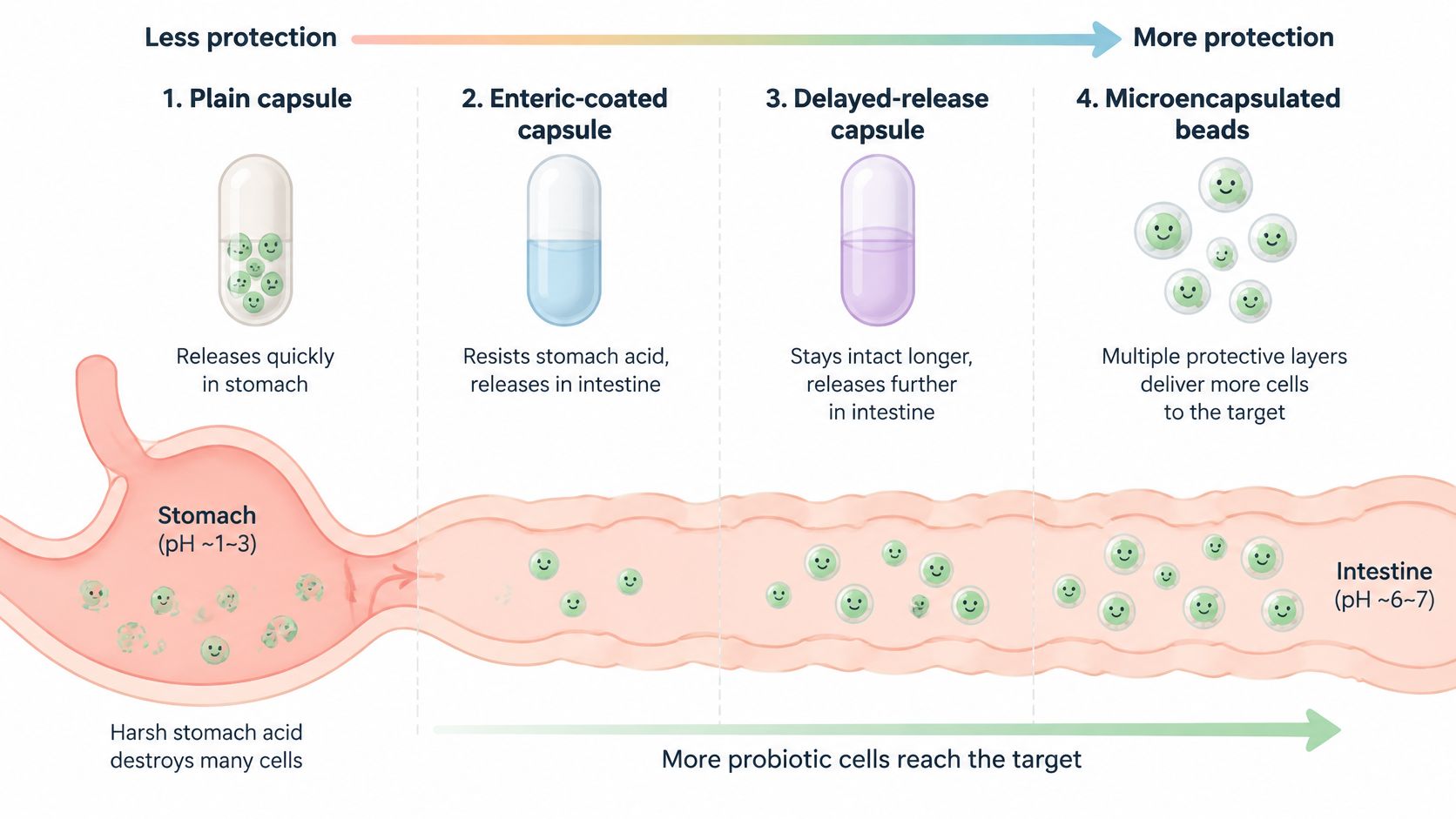
A plain capsule gives cells no dedicated barrier, so they meet the full acid load and survival comes down to strain biology and how the bottle was stored. Microencapsulation wraps cells in a hydrogel or polymer matrix that limits direct contact with acid and pepsin. Encapsulation trials generally report higher retention than the same cells delivered free, and the survival figures earlier in this article show how wide that gap can run under a single set of test conditions. A food matrix buffers acid around the cells, and an enteric or delayed-release coating resists the stomach and releases later in the intestine. GutRx DAILY's plant-based enteric-coated capsule is one commercial example of that delayed-release approach. Capsule shells vary too, and our breakdown of vegan probiotic capsules covers what the shell is made of and why that affects release.
| Delivery format | How it protects cells | What tests show | Main limit |
|---|---|---|---|
| Plain capsule, free cells | No dedicated barrier; cells face full acid exposure | Viability loss varies widely by strain and test | Protection depends on strain and storage |
| Food matrix, such as fermented dairy | Food buffers acid around the cells | Dairy-based products survived significantly better than supplements in a 2025 in-vitro study | Results reflect the food, dose and meal timing |
| Enteric or delayed-release coating | Coating resists acid and releases later in the intestine | Protects in acid simulations; release timing depends on the formulation | Must be verified for the exact strain |
| Microencapsulation, such as hydrogel or polymer | Matrix reduces direct contact with acid and pepsin | Encapsulation generally reports better retention than free cells | Performance varies by product and is not guaranteed |
Three claims that get blended into one
The first claim is survival in simulated gastric fluid, which is what most lab tests measure. The second is recovery of viable cells after intestinal simulation, which fewer products test. The third is a demonstrated human outcome, which requires clinical or pharmacokinetic data and is rarer still.
A coating can satisfy the first and say nothing about the second or third. Protection preserves cells, but it also changes release timing, rehydration and how the dose interacts with food and intestinal contents. Animal-model work on polymer coatings reports large increases in recovered cells after an acid challenge, and results like those describe a mechanism rather than a promise about people.
Time in acid matters as much as the barrier. Even within a single well-characterized strain, extending the exposure window in simulated gastric juice erodes the viable population steadily, so a survival claim has to state its duration before the percentage means anything. A strain that looks durable at 90 minutes can look ordinary at 180.
Two questions settle most of the argument. Was the finished capsule tested, or only the bulk culture that went into it? And were the test conditions close enough to a real stomach (pH, duration, enzymes, meal state) that the result means anything? A delivery claim backed by those two answers is worth comparing. One backed by capsule design alone is an inference.
How to Check a Label for Survival Evidence
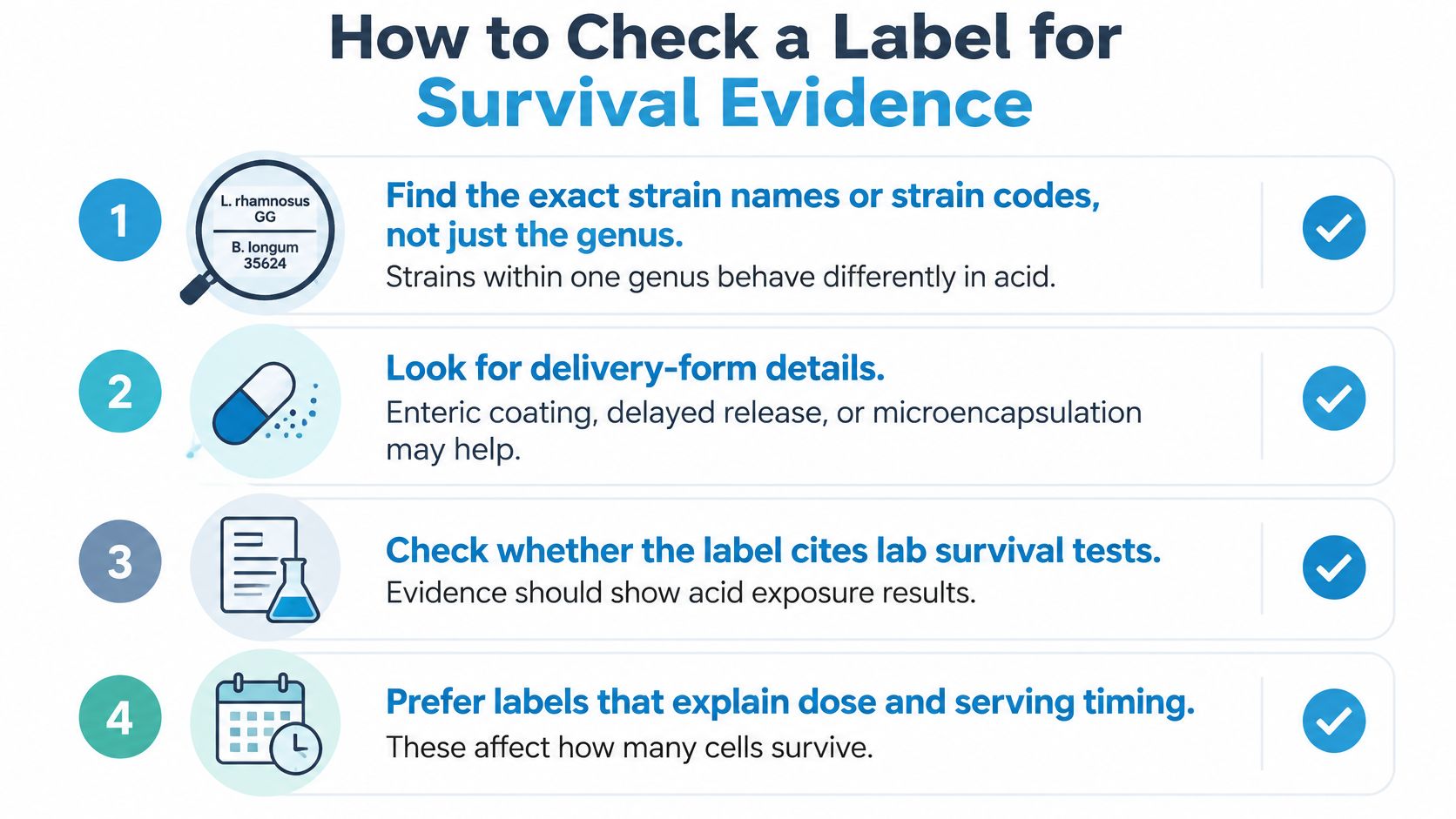
Run this checklist against any product page in about two minutes. Each question maps to something a lab could have measured.
- Do the strains carry codes? Strains within a genus differ in acid tolerance, so a species name alone can't predict survival.
- Is the CFU stated at expiry? Potency at expiry is closer to what your intestine might receive; a manufacture count flatters the product by design.
- Is there acid testing on that strain? Look for the pH, the exposure time, and whether pepsin was included, because those three details decide whether the number means anything.
- What is the delivery format? Plain capsule, enteric coating, delayed release, microencapsulation and food matrix each set a different expectation, and the format should match the claim.
- Was the finished capsule tested, or bulk powder? A culture that survives in a lab dish can still lose viability once it's compressed into a tablet with excipients and stored for months.
- Is there independent verification? A certificate of analysis from a third-party lab should cover the potency you're buying. GutRx publishes downloadable Certificates of Analysis from third-party testing on every batch, so the strain and potency data can be checked against the label.
- What are the storage instructions? Heat and moisture kill cells in the bottle, so a product that sat in a warm warehouse may not deliver its labeled count. GutRx probiotic, fiber and collagen formulas should be refrigerated after opening.
Format changes what the answers mean. Drink powders dissolve before they reach the stomach and behave differently from a swallowed capsule, so the comparison isn't only about CFU. An Australian guide to gut-friendly drink powders explains how those products are built and where a powder fits.
Timing matters as much as the test itself. Each batch of GutRx probiotic bacteria is thoroughly tested when it arrives from suppliers, to confirm the species survived transport before anything is encapsulated.
Keep the limits straight when you read the results. A label can document viable cells in simulated gastric fluid, under stated pH and timing. It cannot document cells reaching your intestine or a measurable human outcome unless that product was studied in people. Most labels stop at the first claim, and the honest ones say so.
A product that answers the strain, expiry and testing questions gives you something to compare. The label tells you how it was tested; it can't tell you what happened inside you.
Choose a Probiotic Built for Gut Delivery
A capsule that survives simulated gastric fluid answers one question. Whether viable cells reach the intestine is a second, and whether those cells change outcomes in human trials is a third. Product pages often present the first answer as if it covered all three, so weigh a formula on what each layer of evidence can show: strain identity written on the label, a format that protects cells through the stomach, and potency that holds to expiry.
GutRx DAILY holds 10 strains and 61 billion CFU with a 400 mg prebiotic blend (acacia senegal, apple, raspberry and black currant extracts) in one capsule a day, and its plant-based, enteric-coated capsule is built to carry those strains through stomach acid. GutRx BALANCE delivers 30 billion CFU in a delayed-release format for live delivery, built around the next-generation strains Akkermansia muciniphila and Christensenella to support a balanced gut microbiome, digestive comfort and the gut lining.
For readers who want everything in one place, GutRx COMPLETE combines probiotics, prebiotics and postbiotics in a single formula with 78 billion CFU.
- Regularity and daily balance: DAILY.
- Microbiome balance and barrier support: BALANCE.
- All-in-one synbiotic: COMPLETE.
Match the formula to the reason you're taking it, then compare strain lists and formats on the product pages rather than the front-of-bottle number. GutRx probiotic formulas should be refrigerated after opening, because the potency that matters is what remains viable at expiry, not the count printed at manufacture. These statements have not been evaluated by the FDA, and these products are not intended to diagnose, treat, cure or prevent any disease.
Frequently Asked Questions
Is a higher CFU count always better?
No. The count is measured at manufacture, so the useful figure is potency at expiry for the named strains. Two products with the same headline number can deliver very different amounts of viable bacteria once strain identity and delivery format are factored in.
Does an enteric coating guarantee the probiotic reaches the intestine?
No. A coating reduces acid exposure and shifts release later, but it still does not prove colonization or symptom change by itself. The stronger signal is testing on the exact finished formulation, because performance can vary between products even when the capsule claim sounds similar.
Do you need to talk to a doctor before taking a probiotic?
Yes, particularly if you have a medical condition, are pregnant, or take medication. Probiotics are supplements, not a diagnosis or a treatment, and persistent or severe digestive symptoms deserve medical evaluation rather than another bottle.
Every GutRx formula starts from the same premise: the strains have to get there to do anything. The label gives you named strains, enteric-coated delivery, third-party testing and downloadable COAs to compare against the bottle, and orders are backed by a 90-day money-back guarantee. For a daily routine aimed at regularity and occasional bloating, compare the strain list and format on GutRx product pages before choosing on CFU alone.


