

No single probiotic is proven best for H. pylori, and the strongest trial evidence supports named strains and multi-strain mixtures only as an add-on to a prescribed antibiotic regimen. Pooled across 14 randomized trials and 1,671 patients, adding a probiotic to eradication therapy lifted intention-to-treat eradication to 83.6% from 74.8%.
Search for the best probiotic H. pylori supplement and the same advice appears everywhere: buy the highest CFU count you can afford, take it while you're on antibiotics, and expect the infection to clear faster. That advice is aimed at the wrong variable. The factors that decide whether a probiotic helps are the strain on the label, the antibiotic regimen the prescriber chose, and whether any trial behind the product matches either of them.
Table of Contents
- Which Probiotics Have H. pylori Trial Evidence
- What Probiotics Can and Cannot Do During Treatment
- How to Read a Probiotic Label for H. pylori
- Safety Limits and Who Should Check First
- When Symptoms Need Testing and How Eradication Is Confirmed
- Confirm Your Plan With a Clinician Before You Buy
- Common Questions About Probiotics and H. pylori
Which Probiotics Have H. pylori Trial Evidence
Probiotics earn their place in H. pylori care as an add-on, and the trial record explains why the word "best" keeps collapsing under scrutiny. A 2007 meta-analysis of 14 randomized trials covering 1,671 patients reported a pooled eradication odds ratio of 1.84 (95% CI 1.34 to 2.54) when a probiotic joined eradication therapy, plus total treatment-related side effects in 24.7% of probiotic-treated patients against 38.5% of controls. Diarrhea carried the sharpest signal of all, a summary odds ratio of 0.44 (95% CI 0.30 to 0.66).
That eradication gain is real but small and fragile. A 2016 meta-analysis of 21 randomized controlled trials found no statistically significant improvement, with an intention-to-treat odds ratio of 1.21 and a 95% CI of 0.86 to 1.69. An interval that crosses 1.0 is what a null result looks like in print. A probiotic that reliably shifts tolerability can still fail to shift cure rates when the regimen underneath it is already struggling against resistance.
Why the pooled numbers disagree
Trials test different things and report them under the same word. One 2016 pooling of 13 randomized controlled trials and 2,306 patients produced an eradication relative risk of 1.15 (95% CI 1.10 to 1.20), a modest but consistent direction, and the same review's 2015 analysis of 23 studies and 3,900 participants put triple therapy alone at 72.26% eradication versus 80.74% with probiotics added. A broader systematic review of 45 randomized controlled trials and 6,997 people reported 82.31% versus 72.08%, with adverse events in 21.44% of probiotic-treated participants against 36.27% of controls, a pooled risk ratio of 0.59.
The side-effect advantage holds up better than the cure-rate advantage. A pooled analysis of triple-therapy trials reported an odds ratio of 0.58 (95% CI 0.50 to 0.68) for treatment failure and fewer cases of nausea, diarrhea, epigastric pain, vomiting, taste distortion and skin rash. Appetite loss was the exception, with an odds ratio of 0.94 that didn't separate the groups.
Trial evidence for probiotics in H. pylori treatment
| Probiotic or analysis | Trials and participants | Eradication result | Side effects or main limit |
|---|---|---|---|
| 2007 meta-analysis | 14 RCTs, 1,671 patients | 83.6% vs 74.8% (OR 1.84) | Side effects 24.7% vs 38.5%; diarrhea OR 0.44 |
| 2016 meta-analysis | 21 RCTs | No significant gain (OR 1.21, 95% CI 0.86 to 1.69) | No significant eradication improvement |
| 2016 meta-analysis | 13 RCTs, 2,306 patients | Pooled RR 1.15 (95% CI 1.10 to 1.20) | Modest average gain, mixed regimens |
| Review of 45 RCTs | 45 RCTs, 6,997 people | 82.31% vs 72.08% | Adverse events 21.44% vs 36.27% (RR 0.59) |
| Triple-therapy meta-analysis | 23 studies, 3,900 participants | 80.74% vs 72.26% (OR 0.58) | Fewer nausea, diarrhea, epigastric pain, vomiting, taste change and rash |
| 2025 pretreatment meta-analysis | 12 RCTs, 2,144 participants | 80.34% vs 70.49% (RR 1.14) | Fewer side effects with pretreatment |
| Lactobacillus reuteri strains | 2024 meta-analysis of RCTs | Eradication improved over control | Fewer GI symptoms; findings stay inside the strains tested |
| Saccharomyces boulardii (yeast) | 2025 meta-analysis of 19 trials, 2,973 participants | Stronger subgroup signal with bismuth quadruple therapy | Yeast, mostly studied within bismuth regimens |
| Multi-strain mixtures | Six mixtures across pooled trials | Four mixtures improved eradication | Five reduced adverse reactions; several rest on limited evidence |
| Lactobacillus added to triple or quadruple therapy | 2025 systematic review of 14 RCTs | Eradication improved overall | Many strains used, so no conclusion for any one Lactobacillus type |
Strain rows, and the limits built into each
Lactobacillus reuteri has the deepest single-strain file, and recent pooling of its randomized trials points the same direction for both eradication and gastrointestinal symptoms. What that file doesn't support is transferability. Results for one strain designation don't carry to a different L. reuteri strain, and they certainly don't carry to an unnamed Lactobacillus blend.
Yeast changes the picture. A 2025 meta-analysis of probiotics added to bismuth quadruple therapy, covering 19 trials and 2,973 participants, found improved eradication with a pooled odds ratio of 1.49, and the subgroup signals were strongest for Saccharomyces boulardii and multi-strain products. The same review group's pooling of 12 randomized trials and 2,144 participants found higher eradication with probiotic pretreatment than control, 80.34% versus 70.49%, a risk ratio of 1.14, plus fewer side effects. If you want the strain-level detail on the yeast, our guide to Saccharomyces boulardii covers what it does and what it doesn't.
Then there's the strain-mix problem. A 2025 systematic review of 14 randomized trials found that Lactobacillus added to triple or quadruple therapy improved eradication overall, but the trials used so many different strains that no individual Lactobacillus type can be singled out, and the reductions in adverse effects and gastrointestinal symptoms weren't statistically significant.
The spread across all of it comes down to four moving parts: the antibiotic regimen, the strain, the dose, and local resistance patterns. No percentage in that table transfers to a bottle on a shelf. Match the strain and the regimen to the trial that studied them, then ignore the CFU number on the front of the box.
What Probiotics Can and Cannot Do During Treatment
Think of a probiotic as a seatbelt for the regimen, not the engine. It doesn't drive the car. It lowers the cost of a rough ride, and a rough ride is exactly what makes people stop taking four drugs a day.
A probiotic doesn't treat the infection. It helps the patient finish the treatment that does.
The World Gastroenterology Organisation's summary of the 2022 Maastricht VI/Florence consensus draws the line precisely there. Probiotics may reduce gastrointestinal side effects during eradication therapy and may modestly improve outcomes, with evidence quality rated weak and the recommendation graded moderate. The same guidance states plainly that probiotics should not be used alone, because there's no evidence that probiotic monotherapy eradicates H. pylori without concurrent antibiotics. The proposed benefit comes mainly from improving tolerance, which helps patients complete the course.
Why tolerance is the mechanism that matters
Diarrhea, nausea, abdominal discomfort and a metallic taste are the reasons people skip doses or quit early. Every skipped dose gives the bacterium more room, so a supplement that keeps someone on schedule is doing real work even if it never touches H. pylori directly.
The proposed mechanisms are plausible enough. Probiotic strains compete with H. pylori for epithelial adhesion sites, produce antimicrobial metabolites such as reuterin, shift local pH, and modulate inflammatory signaling. Plausible mechanisms are not a treatment plan, and none of them justifies using a probiotic alone or delaying antibiotics to try one first.
Three actions follow. Keep the prescribed regimen intact. Report side effects to the prescriber rather than self-adjusting. Never read symptom relief as proof the infection is gone. If you want the wider picture on pairing a probiotic with antibiotics, our guide to the best probiotics for antibiotic use walks through timing and strain choice.
How to Read a Probiotic Label for H. pylori
A label can be screened in about a minute if you know the order to read it. Each check below maps to something a trial measured, not to a marketing preference.
- Strain identity. Look for genus, species and a strain code, such as Lactobacillus reuteri plus a designation. A genus name alone can't be matched to any trial, so it can't inherit any trial's result.
- Dose through expiry. Trials counted viable bacteria at the time of use. Counts fall over shelf life, so a headline CFU figure measured at manufacture tells you almost nothing about what's in the capsule in month eight.
- Delivery. Enteric-coated or delayed-release capsules are designed to move live strains past stomach acid. If the label says nothing about protection, assume there is none.
- Testing. Third-party results or a downloadable certificate of analysis show what a specific batch contains. A claim with no batch data behind it is a hope, not a specification.
- Storage. Look for concrete instructions, including refrigeration after opening where the product requires it. Vague or missing storage guidance is a warning about the formula's stability.
Label checks before buying a probiotic
| Label check | What good looks like | Red flag |
|---|---|---|
| Strain identity | Genus, species and strain code, matched to a trial strain | Genus only, or a blend with no strain IDs |
| Dose | Viable count stated through expiry, as trials counted | Only a high CFU figure at manufacture |
| Delivery | Enteric-coated or delayed-release capsule | No protection from stomach acid stated |
| Testing | Third-party results or downloadable certificate of analysis | Claims with no batch testing |
| Storage | Specific instructions, including refrigeration after opening if required | Vague or missing storage guidance |
Here's how the checks fail in practice. A label that leads with a huge CFU number and lists "probiotic blend" with no strain codes fails checks one and two at once, and no amount of clever packaging fixes that. If you're unsure what that number is even measuring, our explainer on what CFU stands for is the place to start.
Formulation differences aren't a marketing abstraction, either. A review of 19 randomized controlled trials involving 2,730 participants and six multi-strain mixtures found that four mixtures significantly improved eradication rates, five significantly reduced overall adverse reactions, and three reduced antibiotic-associated diarrhea. The authors cautioned that several mixtures rested on limited evidence and that trials using the same formulations are still needed to confirm individual results. Formula identity, not CFU volume, is what separates them.
For context on our own lineup, GutRx Complete is enteric-coated, with 13 strains, 78 billion CFU per three-capsule serving, and prebiotics plus postbiotics including tributyrin. GutRx Balance carries 30 billion CFU per capsule with Akkermansia muciniphila and Christensenella minuta, and it's designed for everyday microbiome balance and the gut lining, not for H. pylori. These statements have not been evaluated by the FDA. These products are not intended to diagnose, treat, cure or prevent any disease.
Safety Limits and Who Should Check First
Many patients tolerate probiotics without trouble. Some shouldn't start one without a conversation first, and that conversation belongs with the clinician who is prescribing the eradication regimen.
Call the clinic before buying if any of these apply: a weakened immune system, current chemotherapy or immunosuppressive drugs, a central venous catheter, a premature infant in the household, serious illness, or recovery from major surgery. Live bacteria and yeast have caused rare bloodstream infections in these groups, which is why the guidance is cautious rather than enthusiastic.
The mild effects worth expecting
During antibiotics, gas, loose stools and bloating are common and often settle within a week or two. Report them to the prescriber anyway. A pattern that's getting worse instead of better is information the clinician needs, and sometimes it means adjusting the regimen rather than adding to it.
Pregnancy and breastfeeding are a separate question. Data for most specific probiotic products in those settings are limited, so the choice should be approved by the clinician managing the pregnancy first.
Check the capsule shell and the full ingredient list if you have allergies, including to dairy or to specific starches and binders.
Stop and call for fever, severe or worsening abdominal pain, blood in the stool, vomiting, or diarrhea lasting more than a few days. A supplement that seemed harmless on day one is not automatically harmless on day nine, and no probiotic is risk-free just because it's sold without a prescription.
When Symptoms Need Testing and How Eradication Is Confirmed
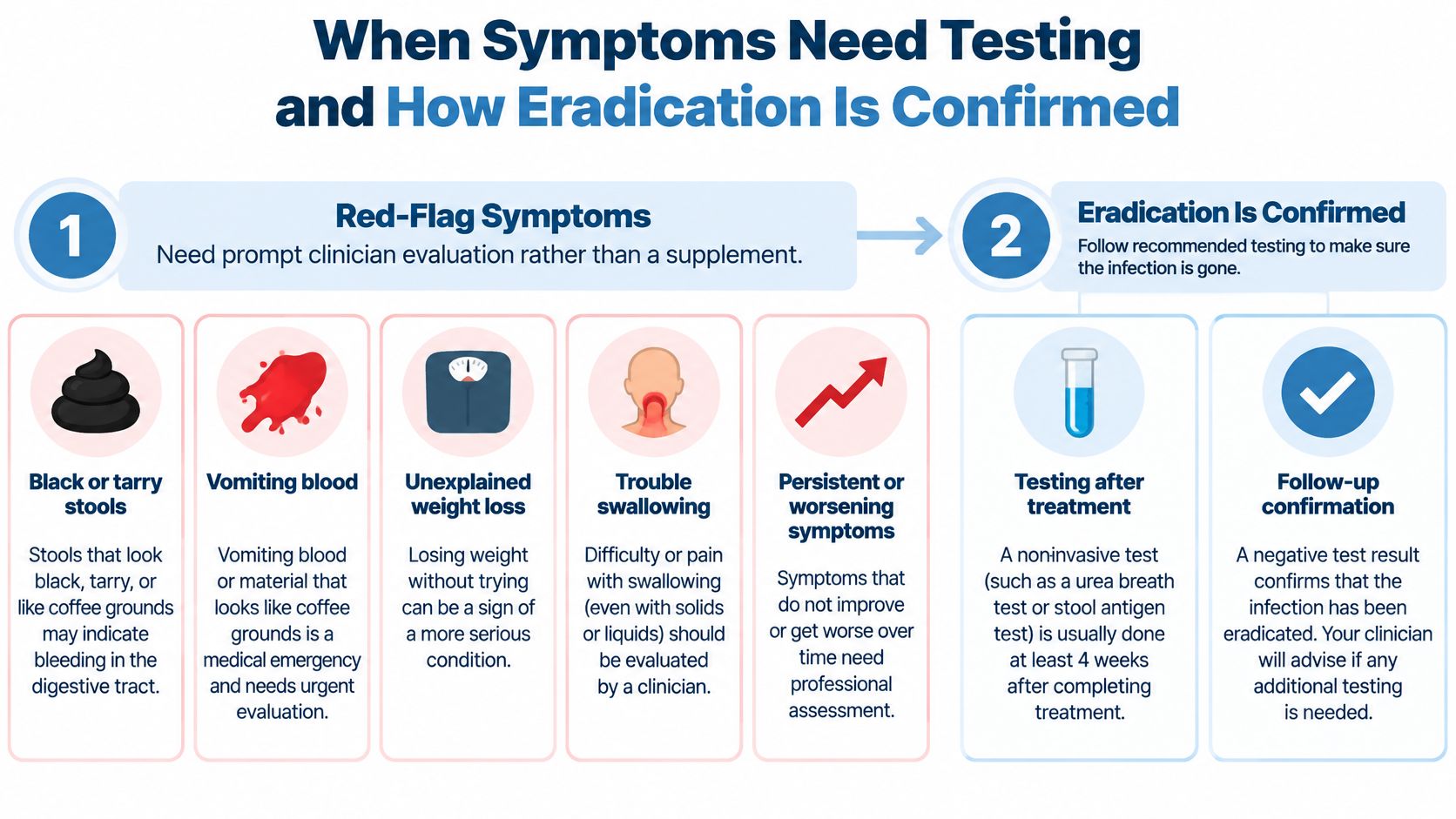
Some symptoms need a clinician now, not a supplement. Black or tarry stools, vomiting blood, unexplained weight loss, trouble swallowing, persistent or worsening upper abdominal pain, signs of anemia, or symptoms that return after treatment all belong in a clinic, promptly.
The sequence that confirms eradication
- Diagnosis first. A clinician orders a urea breath test or stool antigen test. Symptoms alone don't diagnose H. pylori, and neither does a supplement response.
- The prescribed regimen. Antibiotics plus acid suppression, sometimes with bismuth, chosen for local resistance patterns.
- A probiotic alongside it, if the clinician agrees. Verify the exact strain identity, the viable count through shelf life, storage conditions and quality testing. A 2024 meta-analysis of Lactobacillus reuteri trials reported an improvement of roughly 7.4 percentage points in intention-to-treat eradication, reaching about 80.0% in the probiotic group, with fewer treatment-related gastrointestinal symptoms (review record on the Cochrane Library). That's a strain-level result, and it doesn't travel to other species or to an unspecified blend.
- Finish the full antibiotic course. Stop early and you select for resistance while leaving the infection in place.
- Wait, on the clinician's schedule. Testing usually happens about four weeks after antibiotics end. Ask whether acid-reducing medicines should be paused beforehand, since they can skew a breath test.
- Test of cure. A negative result confirms eradication. Symptom improvement does not.
That last point matters more than anything else in this article. Feeling better is not evidence the infection is gone, and neither is a good month on a probiotic. If your clinician orders blood work alongside the breath or stool test, what to do with routine lab results is a sensible primer before the follow-up visit.
Bring five questions to the appointment: which regimen is being used, whether a probiotic is appropriate alongside it, when to test, what to do if symptoms persist, and whether a second course would be needed.
Confirm Your Plan With a Clinician Before You Buy
Confirm the plan with the prescriber first, then buy. A probiotic is a support choice layered onto prescribed treatment, and the order of those two decisions isn't negotiable.
If an eradication regimen is already in place and you want a probiotic alongside it, you need two answers. Does the strain match the trial evidence in the first table, and is the product safe for you specifically? Those are clinician questions, and they take about five minutes to resolve with someone who has your chart.
If the goal is everyday digestive balance rather than H. pylori, that's a different job with different products. GutRx Daily is built for regularity and everyday balance, one capsule a day with 10 strains and prebiotics, and it should be refrigerated after opening. GutRx Balance is the next-generation option at 30 billion CFU per capsule with Akkermansia muciniphila and Christensenella minuta, designed for microbiome balance, digestive comfort and the gut barrier. Our all-in-one synbiotic combines probiotics, prebiotics and postbiotics for broad daily support. These statements have not been evaluated by the FDA, and these products are not intended to diagnose, treat, cure or prevent any disease.
No GutRx product is designed to treat, cure or eradicate H. pylori. None of them replaces antibiotics, testing or a diagnosis, and nothing on a supplement shelf should delay a breath test.
One next step. Bring the label and the comparison table in this article to your appointment, ask the two questions above, and book the test of cure before you spend money on anything else.
Common Questions About Probiotics and H. pylori
Can a probiotic cure H. pylori on its own? No. The consensus summary described earlier found no evidence that probiotic monotherapy eradicates the infection without concurrent antibiotics, and every credible trial in this space adds probiotics to a regimen rather than substituting for one.
Can children take a probiotic during H. pylori treatment? Ask the child's clinician first, because the prescribed regimen and the child's overall health come before any supplement decision. GutRx KIDS Gummies (ages 3 to 12) are designed for kid-appropriate probiotic and prebiotic support, not for H. pylori. These statements have not been evaluated by the FDA.
Should I tell my clinician about a probiotic before testing? Yes. Bring the label and a full list of supplements so the clinician can plan testing with a complete medication picture, including anything that might interfere with a breath test.
Do I need a prescription for a probiotic? No, supplements are sold over the counter. The antibiotic regimen that clears H. pylori does require a prescription, and a probiotic should be chosen alongside that regimen rather than in place of it.
If you're looking for everyday digestive support rather than an H. pylori strategy, GutRx builds synbiotics around documented strains, third-party testing with downloadable certificates of analysis, and formulas made in a GMP-certified facility in the USA. Start with GutRx to see which formula fits your goal, whether that's regularity, microbiome balance, or a combined pro, pre and postbiotic approach, and bring the label to your next appointment.


