
The best probiotics for women aren't chosen by the highest CFU count, the prettiest packaging, or the word “women” on the bottle. The useful question is which exact strain, delivery route, and formulation match your main symptom. A product aimed at bloating and IBS-type discomfort may not be the right choice for recurrent urinary tract infections, and an oral capsule isn't interchangeable with a vaginal probiotic.
That distinction matters because the strongest evidence is strain-specific and indication-specific. Gut symptoms, bacterial vaginosis, vaginal balance, and recurrent UTI prevention involve different targets, so a practical choice starts with the problem you're trying to support, not your gender alone.
Table of Contents
- Why One Probiotic Does Not Fit Every Woman
- Probiotic Strains with Evidence for Gut Symptoms in Women
- Vaginal and Urinary Health Probiotics and the Route Question
- How to Read a Probiotic Label Like a Clinician
- Matching Your Symptoms to the Right Probiotic Formulation
- Quality Markers That Separate Reliable Probiotics from Marketing Hype
- Dosing Timing and Safety Guidance for Women Starting Probiotics
Why One Probiotic Does Not Fit Every Woman
Choosing a probiotic starts with the symptom, then the strain and delivery route, not with the highest CFU count or the word “women” on the bottle. Probiotics are not interchangeable just because they belong to the same genus. Lactobacillus is a broad category. Lactobacillus rhamnosus GR-1, Lactobacillus crispatus, and Lactiplantibacillus plantarum 299v are distinct strains with different research histories and intended uses.
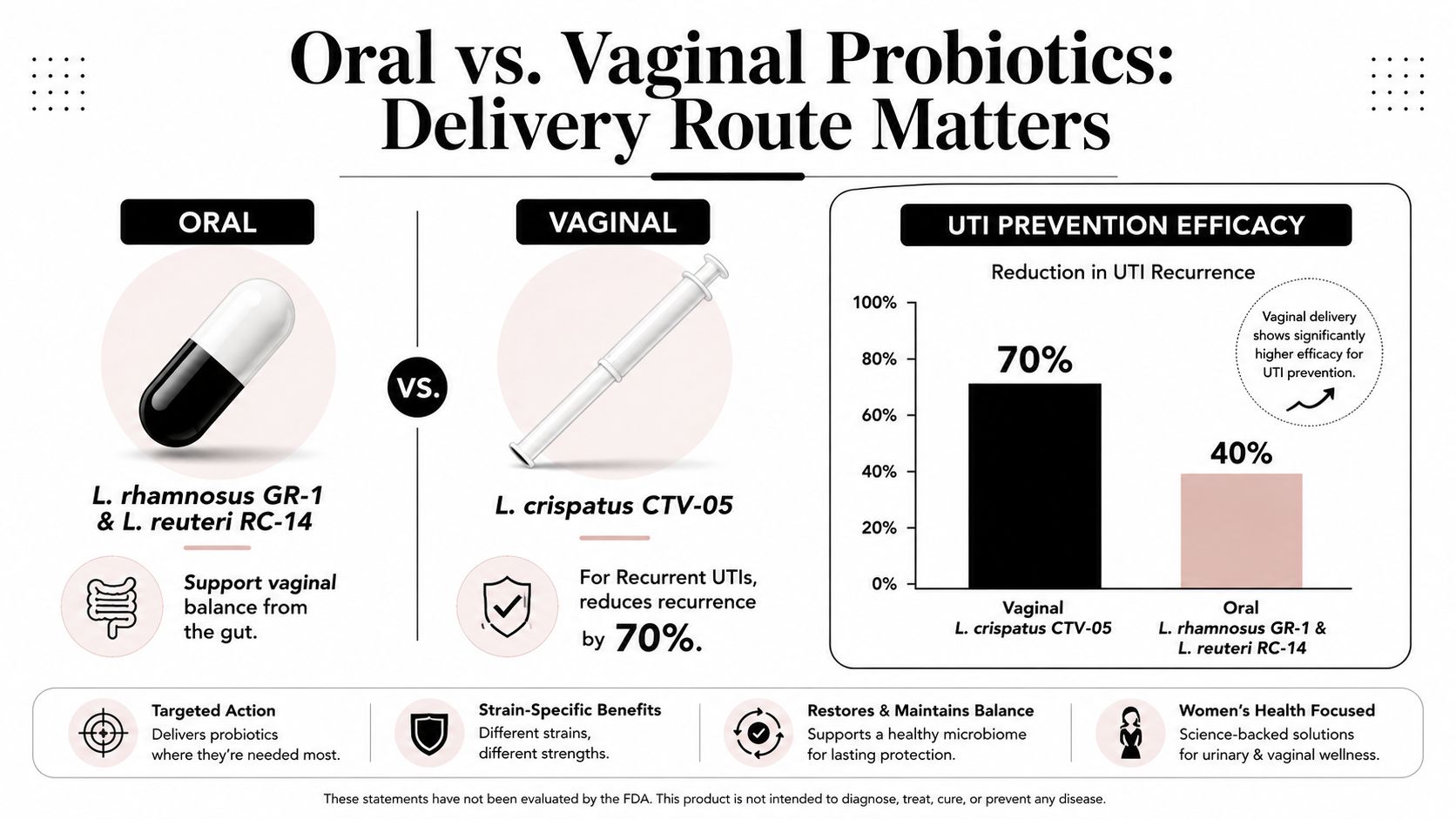
For bloating, a gut-focused formula may be reasonable. Recurrent UTIs require a different assessment: has the specific strain been studied for urinary recurrence, and was it taken orally or administered vaginally? Findings summarized by the American Academy of Family Physicians illustrate the trade-off. In a randomized trial involving premenopausal women with frequent UTIs, symptomatic UTI at 4 months occurred in 70% of the placebo group, 61% of the oral-probiotic group, 41% of the vaginal-probiotic group, and 32% of the combined group. At 12 months, the corresponding rates were 95%, 77%, 61%, and 55%.
The label doesn't define the treatment target
These findings do not mean that every vaginal probiotic will outperform every oral product. They show that route of administration can change the outcome within a particular population and regimen. Oral products may suit people seeking digestive support or a noninvasive routine, while vaginal products place selected organisms closer to the vaginal ecosystem.
The same logic applies to gut complaints. A product containing a well-studied IBS strain may be more rational for abdominal bloating or pain than a broad blend chosen mainly for a long ingredient panel. A urinary-support formulation may contain Lactobacillus strains studied in relation to the vaginal and urinary tract, rather than strains selected only for intestinal digestion.
Practical rule: Match the strain and route to the symptom. Do not match a gender label to a vague promise.
A probiotic also should not be chosen with the expectation that it will permanently “colonize” the body. A systematic review of probiotics for vaginal health indicates that probiotic strains often are not detected long after dosing stops. These products may act as transient ecological modulators, so consistent use and a realistic goal matter more than expecting one bottle to permanently rebuild the microbiome.
Probiotic Strains with Evidence for Gut Symptoms in Women
The 2026 umbrella review on strain-specific IBS evidence supports a practical conclusion: genus-level advice is too blunt. “Choose Lactobacillus” does not identify a product studied for bloating, pain, irregularity, or diarrhea-related discomfort. The review found modest improvements in IBS, including small reductions in overall symptoms, pain, and abdominal bloating, with results tied to selected strains rather than probiotics as a universal category. See the strain-specific IBS evidence review for the underlying analysis.
Bifidobacterium longum 35624
Bifidobacterium longum 35624 is one of the strains identified as beneficial for IBS-related outcomes. It may suit someone with a broad IBS symptom pattern, especially when abdominal discomfort, bloating, and bowel-pattern changes occur together.
Read the label carefully. “Bifidobacterium longum” does not confirm the presence of 35624. Evidence linked to 35624 should not automatically be applied to another Bifidobacterium strain.
Lactobacillus rhamnosus GG
Lactobacillus rhamnosus GG, often abbreviated as LGG, is another selected strain associated with gut-related support in the 2026 strain-specific review. It may be relevant for digestive balance or gut barrier support, but products containing L. rhamnosus are not interchangeable.
The strain designation is part of the organism's identity. A label listing only “L. rhamnosus” does not provide enough information to compare the formula with the research.
Lactiplantibacillus plantarum 299v
Lactiplantibacillus plantarum 299v has evidence for IBS-related symptoms, including abdominal bloating and pain. It is a more focused option for someone whose main complaints are gas, visible distension, or abdominal discomfort, rather than vaginal or urinary symptoms.
Persistent, severe, or changing symptoms need assessment instead of indefinite supplement trials. Bloating can reflect several causes, including functional gut discomfort, constipation, diarrhea, food-related symptoms, or a condition requiring medical care. Probiotic selection is more useful after the symptom pattern is clear.
Saccharomyces cerevisiae CNCM I-3856 and Bacillus coagulans Unique IS2
The review also reported benefits for selected non-Lactobacillus organisms, including Saccharomyces cerevisiae CNCM I-3856 and Bacillus coagulans Unique IS2. These findings reinforce the main point: the exact organism and strain matter more than a product's broad category or a long ingredient list.
For a closer examination of strain selection for digestive goals, use this guide to probiotic strains for gut health.
Vaginal and Urinary Health Probiotics and the Route Question
Among the probiotic regimens studied for recurrent UTI, intravaginal Lactobacillus has the clearest signal, especially in the populations and treatment schedules examined. A 2026 meta-analysis of four randomized controlled trials involving 616 participants found fewer recurrent UTIs with probiotics than with placebo. For intravaginal Lactobacillus crispatus, the most precise estimate showed a relative risk of 0.50, with a 95% confidence interval of 0.20 to 1.20, with recurrence rates of 15% versus 27% in the placebo group.
That confidence interval remains wide, so the finding does not guarantee protection for every woman. The more practical conclusion is that route of administration matters. Intravaginal delivery consistently trended toward greater benefit because it places Lactobacillus closer to the vaginal environment that treatment aims to recolonize.
Oral and vaginal products serve different purposes
Oral probiotics may still suit women who want a convenient daily routine. Earlier randomized evidence found that oral Lactobacillus rhamnosus GR-1 plus L. fermentum RC-14 was safe in 64 healthy women over 60 days and improved vaginal flora by increasing lactobacilli while reducing yeast and coliforms. That combination provides a rationale for oral use when digestive and vaginal support are both part of the goal, although it should not be treated as interchangeable with a vaginal regimen.
The UTI trial described by the American Academy of Family Physicians found that oral-only use performed less strongly than vaginal delivery in that specific population. Combined oral and vaginal use produced the lowest recurrence pattern at the measured time points, but these results do not establish that adding an oral product is always better than vaginal use alone.
Bacterial vaginosis requires a separate evidence standard
Bacterial vaginosis, or BV, has its own outcome measures. Researchers assess changes with the Nugent score and Gardnerella vaginalis counts, rather than relying only on subjective symptom improvement.
In one randomized, placebo-controlled trial of selected vaginal Lactobacillus strains, the probiotic group had a significant Nugent score reduction from a median of 3.0 to 2.0, with mean values falling from 3.9 to 2.6. Gardnerella counts also dropped from log10 3.57 to 2.38. The review described evidence that vaginal probiotic tablets could increase BV cure rates and improve the vaginal environment. More recent trial evidence found that MED-01 reduced Nugent score and eased discharge, dysuria, and burning without adverse events. A 2026 PubMed review concluded that evidence remains insufficient to recommend routine probiotics for optimizing vaginal microbiota and inflammation.
The distinction matters in practice. Evidence for reducing BV recurrence is stronger than evidence for vulvovaginal candidiasis, and a Lactobacillus-dominant ecosystem appears central to the proposed benefit. For strain and route considerations, see this women's probiotic guide for vaginal health.

How to Read a Probiotic Label Like a Clinician
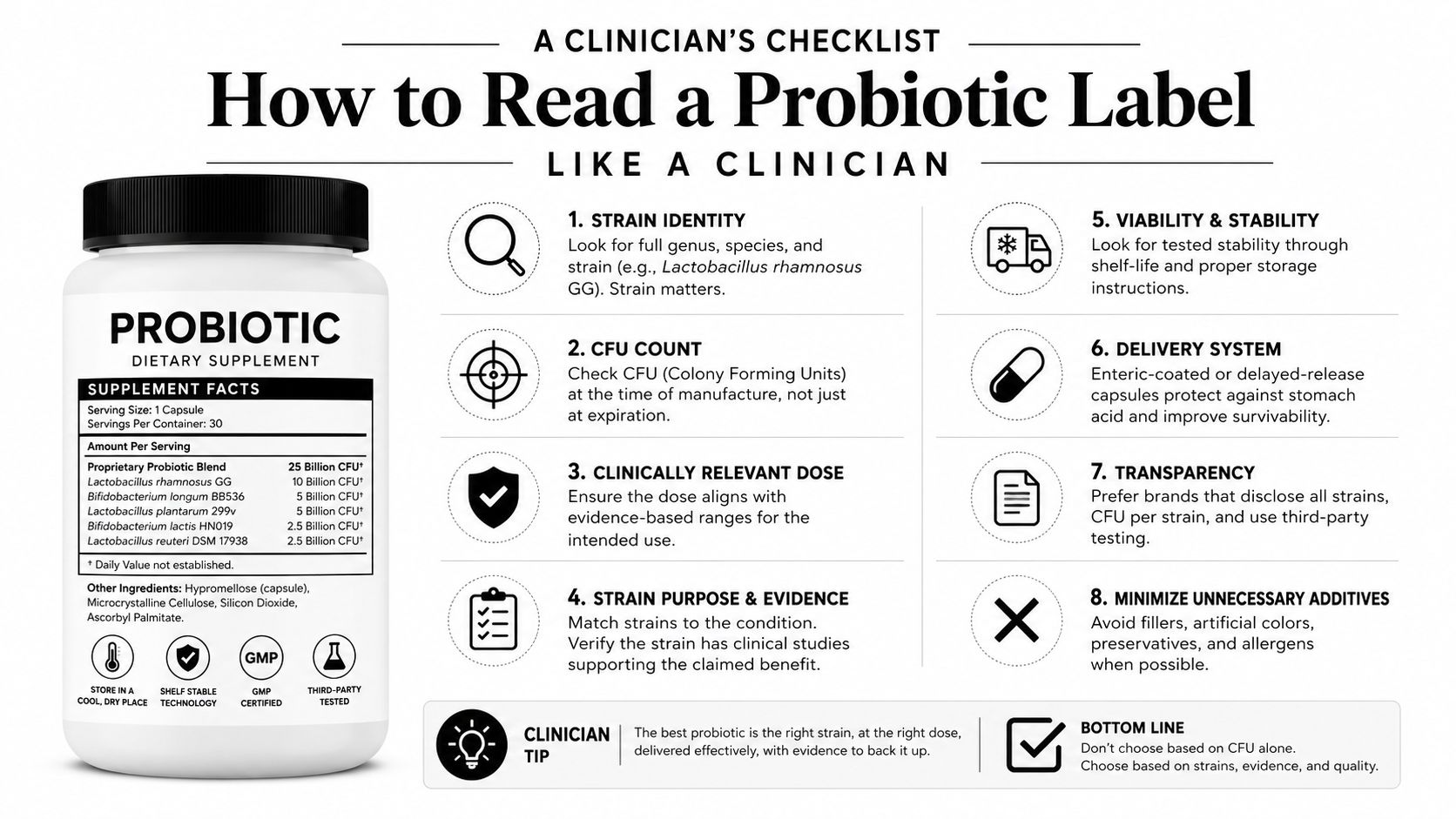
Clinicians read probiotic labels in a set order. The first check is the complete strain name, because genus and species alone do not identify the formulation studied in research. Useful examples include Bifidobacterium longum 35624 and Lactobacillus rhamnosus GG. “Proprietary blend” wording makes comparison difficult if it omits the strains present or the amount of each organism.
Use this label checklist
-
Clarify the target. Identify whether the formula addresses bloating, irregularity, diarrhea support, vaginal balance, or recurrent UTI prevention. A broad “women's wellness” claim does not explain which outcome the product is intended to support.
-
Verify potency language. CFU means colony-forming units. A higher figure does not establish better performance. Check whether the dose resembles research on the exact strain and whether potency is guaranteed through expiry, rather than stated only at manufacture.
-
Look for quality documentation. Third-party testing should verify identity, purity, and potency. A downloadable Certificate of Analysis, or COA, provides more detail than a badge printed on the front of the bottle.
-
Assess delivery protection. Delayed-release or enteric-coated capsules may suit gut-focused products because they are designed to protect contents during stomach passage. That feature does not determine suitability for vaginal or urinary goals. Those uses require a separate route decision.
-
Check the supporting ecosystem. A synbiotic combines probiotics with prebiotics. A postbiotic contains nonliving microbial components or metabolites. Either addition may have a role, but neither replaces clear strain identification.
-
Confirm practical fit. Check storage requirements, capsule materials, allergens, and certifications such as vegan or non-GMO status. Shelf-stable products can be easier to use consistently, provided product-specific data support stability.
Use this clinician's checklist for reading a probiotic label while comparing products on Amazon. Prioritize strain identity, intended symptom, delivery system, expiry potency, testing access, and storage instructions. CFU totals and “women's” branding should come later in the decision.
Matching Your Symptoms to the Right Probiotic Formulation
A woman with recurrent UTIs and another with chronic bloating need different probiotic strategies. Map the symptom cluster to the strain and delivery route before comparing brands.
| Primary Symptom | Evidence-Backed Strains | Delivery Route | Key Product Features |
|---|---|---|---|
| IBS-related bloating and pain | Bifidobacterium longum 35624, Lactiplantibacillus plantarum 299v | Usually oral in gut-focused products | Complete strain ID, transparent dose, delayed-release protection where appropriate |
| Broad IBS symptoms | Bifidobacterium longum 35624, Lactobacillus rhamnosus GG, selected strains identified in strain-specific reviews | Oral | Symptom-focused formula, third-party testing, realistic claims |
| Diarrhea-related discomfort | Saccharomyces cerevisiae CNCM I-3856 and selected evidence-backed strains | Oral | Exact strain designation, storage guidance, medication review |
| Recurrent UTI prevention | Intravaginal Lactobacillus crispatus; selected Lactobacillus regimens | Intravaginal evidence is strongest | Route-specific instructions, clinician involvement, strain verification |
| Vaginal balance and BV recurrence support | Selected vaginal Lactobacillus strains | Vaginal or oral, depending on the studied regimen | Lactobacillus focus, evidence for Nugent score or recurrence outcomes |
| Combined digestive and women's support | Strains matched to each separate goal | Oral, unless a vaginal product is indicated | Clear separation of gut and urogenital claims, prebiotic or postbiotic support where relevant |
For bloating and irregularity
Bloating, abdominal pain, gas, and irregularity point toward a gut-focused formulation. The strain-specific evidence supports considering B. longum 35624, L. rhamnosus GG, or L. plantarum 299v. A product listing several Lactobacillus species without complete strain designations gives you less useful information.
Assess the response over a consistent routine rather than after one dose. Results depend on the strain, dose, diet, bowel pattern, and underlying cause of symptoms. New or persistent abdominal pain also deserves medical assessment.
For vaginal or urinary concerns
Recurrent UTI prevention raises a route question before a brand question. Oral digestive probiotics should not be treated as equivalent to a studied intravaginal regimen. Look for evidence tied to intravaginal Lactobacillus crispatus or another clearly identified Lactobacillus regimen, and discuss route-specific use with a clinician.
BV-related products should have evidence connected to vaginal Lactobacillus and objective outcomes, such as Nugent score or recurrence. Persistent discharge, burning, pain, odor, urinary pain, or repeated symptoms call for clinical evaluation instead of repeated self-treatment.
For overlapping needs
Some women want one product for digestive, vaginal, and urinary support. GutRx Women's is described as combining probiotics and prebiotics for those areas, with cranberry and postbiotic ingredients. That convenience can be useful, but evaluate each claim separately. Confirm which strains correspond to gut symptoms, which evidence relates to vaginal or urinary outcomes, and whether the studied route matches the product's instructions.
A combined label cannot substitute for a formulation matched to the actual symptom pattern. When the goals involve different body sites, separate products or clinician guidance may provide a clearer strategy.
Quality Markers That Separate Reliable Probiotics from Marketing Hype
Marketing borrows scientific language such as “clinically tested” and “third-party verified,” then often omits the details that determine whether a product fits the evidence. Reliable evaluation starts with strain identity, documented potency, and quality controls that remain meaningful through the product's shelf life.
Third-party testing can verify identity, purity, and potency. Prefer products with accessible certificates of analysis rather than a general “lab tested” statement. This third-party testing guide explains why public documentation gives buyers a better basis for comparison.
What deserves attention
- Strain identity: Genus and species do not fully identify a strain when clinical evidence is strain-specific. Look for the complete designation.
- Potency at expiry: Check whether the stated CFU amount is guaranteed through expiration, rather than measured only at manufacture.
- Delivery system: Delayed-release protection may suit a gut-targeted product. It does not establish that an oral product is appropriate for vaginal use.
- Storage stability: Shelf stability can make daily use easier. Follow the printed storage instructions, and do not assume refrigeration alone indicates better quality.
- Manufacturing standards: Made in the USA, vegan, gluten-free, and non-GMO descriptions can address personal requirements, but they do not replace strain-specific clinical evidence.
- Expert oversight: Medical-expert involvement is more meaningful when the manufacturer also explains its strain selection, testing, and formulation decisions.
A high CFU count or long ingredient list cannot show that the product matches a particular symptom. Check whether the named organism, formulation, and intended route correspond to the research. Sustained use may also matter because vaginal probiotics can act as temporary ecological modulators rather than permanent colonizers. Reliable products make those limits easier to see, while marketing-led labels leave the buyer to infer them.
Dosing Timing and Safety Guidance for Women Starting Probiotics
Probiotic dosing in clinical trials spans a wide range, from 10^4 to 10^10 CFU, depending on the condition and route of administration. Treatment periods also varied from 5 days to 12 months. Vaginal and recurrent UTI research used different oral and vaginal regimens, so copying a dose between products is unreliable.
Follow the product label. Many oral probiotics can be taken with or without food, but formulation instructions take priority. Daily consistency usually matters more than taking a capsule only when symptoms appear. Ask a pharmacist or clinician how to separate a probiotic from an antibiotic, because the appropriate timing depends on the product and medication.
Gas or bloating may occur after starting a new formula. Persistent or worsening symptoms call for reassessment. Probiotics should not delay care for ongoing diarrhea, blood in stool, significant pain, fever, recurrent urinary symptoms, unusual vaginal discharge, or burning.
Pregnant women, people who are immunocompromised, and those with serious underlying illness should consult a qualified healthcare professional before starting a probiotic, especially a vaginal product. Choose the strain and route first, then compare testing, storage, delivery system, and convenience. That approach is more reliable than searching for one universal “best probiotics for women” product.
GutRx offers women-focused digestive, vaginal, and urinary support through its GutRx Women's formula, alongside products for broader digestive needs. Review strain information, testing documentation, and intended use at GutRx, then match the formulation to your primary symptoms and discuss vaginal or urinary concerns with a healthcare professional.


