

If dairy, beans, or a high-FODMAP meal reliably leave you bloated, gassy, or rushing to the bathroom, IBS digestive enzymes may help, but only when the enzyme matches the food trigger. They aren't a universal treatment for IBS, and taking a broad blend every day won't necessarily address symptoms caused by gut sensitivity, motility, or unrelated foods.
That distinction matters because IBS is common, but its measured prevalence changes substantially with diagnostic criteria. A large meta-analysis estimated worldwide prevalence at 11.2%, while Rome III criteria produced an estimate of 9.2% and Rome IV produced 3.8%, showing how much the definition changes the apparent burden of disease (meta-analysis of IBS prevalence). For people shopping for digestive enzymes for bloating after eating, the practical question isn't whether enzymes are fashionable. It's whether a specific food component is driving a predictable symptom pattern.
Table of Contents
- Understanding IBS Digestive Enzyme Support
- Evidence for Enzyme Therapy in IBS Symptoms
- Enzyme Types Targeting Specific Food Triggers
- Timing, Dosing, and Practical Use Guidelines
- Safety, Limitations, and When to Consult a Clinician
- Building Your Enzyme Support Protocol
Understanding IBS Digestive Enzyme Support
You eat ice cream after dinner and wake up with abdominal discomfort. Beans cause gas every time, while rice and chicken don't. A creamy pasta dish brings bloating and loose stools, but a meal without dairy feels manageable. Those patterns suggest that a food-specific digestion problem may be contributing to symptoms, although they don't prove that IBS is caused by an enzyme deficiency.
Digestive enzymes help break food components into smaller substances. Supplemental enzymes may support this process when a particular carbohydrate is difficult to digest or absorb. Lactase, for example, targets lactose in dairy. Alpha-galactosidase targets certain carbohydrates in legumes and cruciferous vegetables. A FODMAP-targeting blend may address more than one fermentable carbohydrate.
The mistake is treating all post-meal discomfort as the same problem. IBS can involve abdominal pain, bloating, diarrhea, constipation, altered motility, and heightened sensitivity to normal digestive activity. Enzymes can potentially reduce the amount of a trigger substrate reaching the lower gut, but they don't correct every mechanism behind IBS.
Practical rule: If your symptoms don't follow a recognizable food trigger, a meal-specific enzyme trial is less likely to provide a clear answer.
The trigger comes before the supplement
Start with the meal, not the bottle. Keep a simple record of what you ate, when symptoms began, and whether the main problem was gas, bloating, pain, diarrhea, or constipation. A pattern that repeats after dairy points toward a different experiment than a pattern that follows lentils, broccoli, or cauliflower.
FODMAPs are fermentable carbohydrates that can draw water into the intestine and contribute to gas production. If bloating and constipation occur together, a practical overview of the relationship between FODMAPs and constipation relief can help you distinguish food-trigger management from broader bowel-pattern support.
A useful introduction to enzyme supplements for digestion can also clarify why a product containing several enzymes isn't automatically more appropriate. Targeted support is the central idea. Lactase makes sense with lactose. Alpha-galactosidase makes sense with galacto-oligosaccharides. A general digestive enzyme may be poorly matched to the food causing your symptoms.
IBS digestive enzymes are therefore best viewed as a tool for meal-related symptom management, not as a cure for IBS. They may be worth considering when symptoms are predictable, food-linked, and compatible with the enzyme's intended target. They are less convincing as a daily preventive product for unexplained or constantly changing symptoms.
Evidence for Enzyme Therapy in IBS Symptoms
The evidence is promising in specific situations, but it isn't strong enough to support a blanket recommendation for every person with IBS. The clearest signal comes from matching an enzyme to a fermentable carbohydrate, rather than assuming that a broad blend will improve the entire condition.
A placebo-controlled crossover pilot found that alpha-galactosidase reduced next-morning abdominal pain and bloating after participants consumed a high-galactoside challenge. That finding supports a narrow use case. If legumes or similar foods reliably trigger symptoms, breaking down part of the problematic carbohydrate load may reduce fermentation-related discomfort. It doesn't show that alpha-galactosidase controls IBS unrelated to those foods.
What the newer blend data suggests
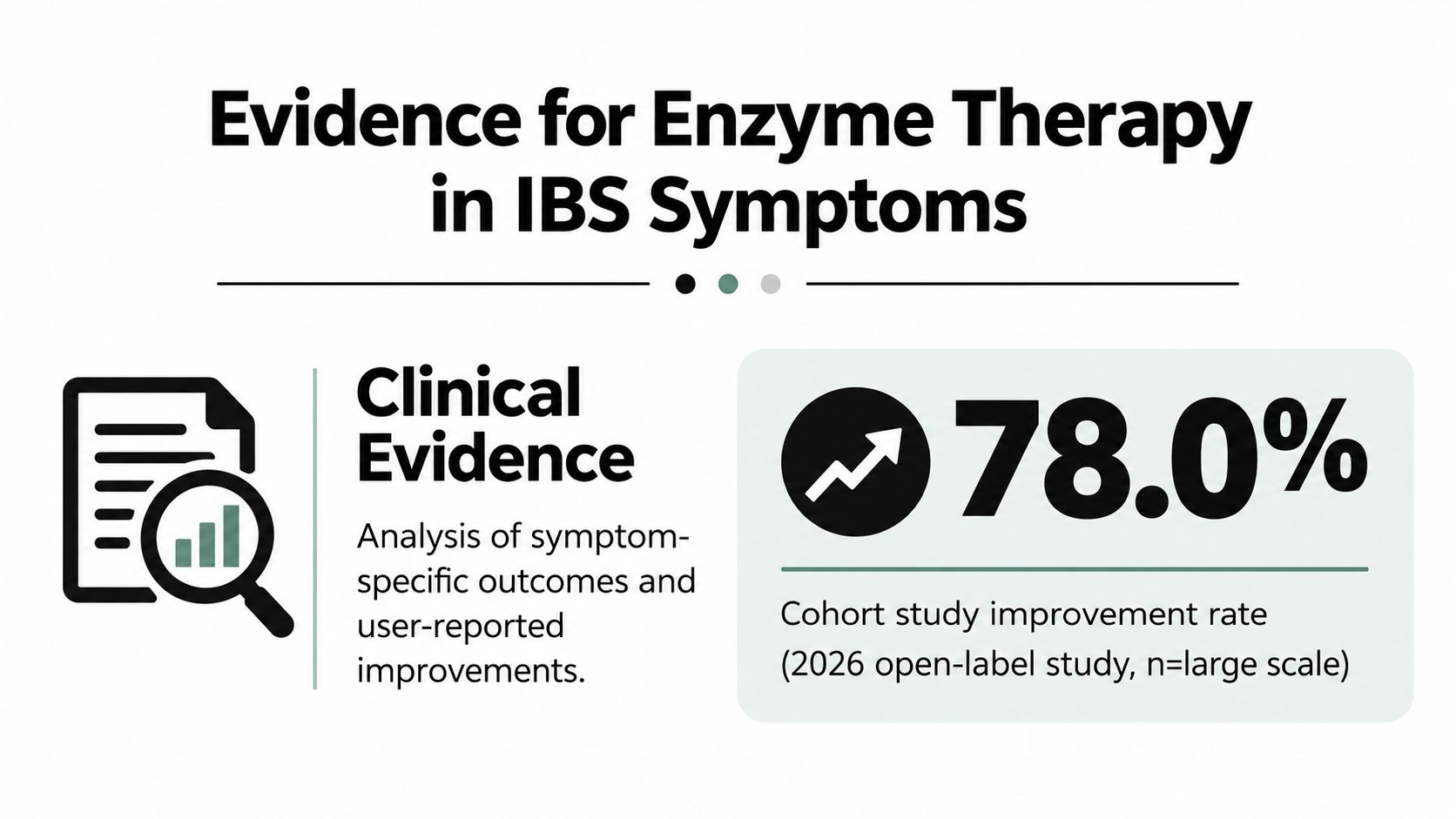
A 2026 open-label cohort study of a FODMAP-targeting digestive enzyme blend reported that after 4 weeks, 78.0% of users improved in bloating and flatulence, 75.0% of participants with IBS-D improved in diarrhea, 72.7% of participants with IBS-C improved in constipation, and 65.3% improved in abdominal pain (FODMAP-targeting enzyme blend study). These are useful symptom-specific signals, especially for people whose discomfort follows meals containing fermentable carbohydrates.
The design matters. An open-label cohort measures what participants report during use, but it doesn't provide the same level of certainty as a blinded comparison with placebo. The results also don't establish that every person with IBS will respond, that the benefits will continue indefinitely, or that the blend is superior to identifying and avoiding a specific trigger.
A separate randomized study involving 43 patients with inflammatory bowel disease plus IBS symptoms found that a digestive enzyme supplement reduced abdominal pain, bloating, and flatulence after 4 weeks compared with conventional treatment alone. That population differs from people with uncomplicated IBS, so the result shouldn't be transferred automatically to every supplement shopper.
For a product example, GutRx MEALTIME is described as a digestive enzyme supplement that supports digestion, reduces bloating, and enhances nutrient absorption. The relevant buying question remains whether its enzyme profile matches your meals and whether its labeling provides enough information to evaluate that match.
Where the evidence remains limited
Reviews of enzyme therapy describe potential relief for post-meal distension, flatulence, bloating, and diarrhea, while constipation responses are less consistent. Older literature also concluded that enzymes beyond lactase hadn't been evaluated carefully enough to recommend them as a general IBS treatment. Alberta Health Services likewise reports insufficient evidence to recommend digestive enzymes broadly for IBS symptom management (Alberta Health Services IBS nutrition guidance).
That leaves a sensible middle position. Enzyme therapy has a real rationale for selected triggers, but broad IBS control remains unproven. A useful discussion of IBS treatment guidelines can help place enzymes alongside diet, bowel-pattern management, and clinician assessment instead of treating them as a replacement for those measures.
Enzyme Types Targeting Specific Food Triggers
Not all digestive enzymes solve the same problem. The label should tell you which food component the formula is designed to break down, and you should be able to connect that target to your own symptom history.
| Enzyme | Food Target | Evidence Level | IBS Symptom Relief |
|---|---|---|---|
| Lactase | Lactose in milk, ice cream, yogurt, and other dairy foods | Most established for lactose-related symptoms | May support less bloating, gas, pain, or diarrhea after dairy |
| Alpha-galactosidase | Galacto-oligosaccharides in beans, lentils, peas, and some cruciferous vegetables | Targeted clinical signal, but not a general IBS treatment | May help gas and bloating after high-galactoside foods |
| FODMAP-targeting blend | More than one fermentable carbohydrate, depending on the formula | Emerging and mixed | May support meal-related bloating, flatulence, diarrhea, and some other symptoms |
| Protease, lipase, and amylase | Protein, fat, and starch | General digestive roles, limited IBS-specific evidence | May be relevant to selected meal discomfort, but doesn't establish IBS benefit |
| Sucrase | Sucrose and related carbohydrates | Adult evidence remains limited to case reports | Not enough evidence for routine IBS use |
| Pancreatic enzymes | Broad digestion of fat, protein, and carbohydrate | Not a standard IBS treatment | Pancreatic enzyme therapy is virtually never recommended for IBS |
Match the ingredient to the meal
Lactase is the straightforward choice when lactose is the suspected trigger. Alpha-galactosidase is more relevant when beans, lentils, peas, broccoli, cauliflower, or Brussels sprouts produce predictable gas and bloating. A detailed guide to an alpha-galactosidase supplement can help you understand why the ingredient is used for those foods rather than for every digestive complaint.
Broad blends containing proteases, lipases, and amylases are often marketed for heavy meals, but the presence of more ingredients doesn't prove better IBS support. The formula may contain enzymes that don't address your trigger, or additives that make the product harder to tolerate. Read the intended food targets before focusing on the size of the ingredient list.
For contrast, GutRx BALANCE offers 30 billion CFUs per capsule with next-generation probiotics for gut health, digestive balance, and immune support. That's a microbiome-oriented product description, not the same thing as a lactase or alpha-galactosidase intervention. Probiotics and enzymes may occupy different roles, and one shouldn't be presented as a substitute for the other.
Timing, Dosing, and Practical Use Guidelines
Timing is central to an enzyme trial. A targeted enzyme needs to be present when the food containing its substrate is being eaten. Taking it hours after a meal, or on an empty stomach as a general daily habit, doesn't test the product fairly.
Use a simple process:
- Choose one trigger. Start with dairy, legumes, or another food that produces a repeatable reaction. Don't change several foods and supplements at the same time.
- Read the product directions. Enzyme activity and dosing depend on the specific ingredient and product. A lactase product and a multi-enzyme formula shouldn't be treated as interchangeable.
- Take it with the meal. Use the product immediately before or at the start of a meal that contains the suspected trigger, following the label's instructions.
- Track the response. Record the meal, dose, symptom type, symptom intensity, and timing. Look for a consistent difference rather than judging the product after one unusually large meal.
- Stop if the trial creates problems. New pain, worsening diarrhea, or a clear pattern of intolerance is a reason to discontinue and reassess.
The right dose isn't one-size-fits-all. The NIH Office of Dietary Supplements makes the same principle clear for probiotic products, stating that the appropriate dose depends on the specific strain and product, and that recommendations should use strains, doses, and durations shown to be beneficial in human studies (NIH probiotic guidance). Enzyme products also require product-specific judgment because activity can differ between ingredients and formulations.
Meal-specific use beats automatic use: Take an enzyme because the meal contains its target, not because the calendar says it's time for a capsule.
A low starting amount can make sense when the label permits it, particularly for someone sensitive to supplements. Continue observing over a practical trial period, then decide whether the benefit is clear enough to justify continued use. If there is no repeatable improvement when the enzyme is used correctly with the suspected food, increasing complexity usually isn't the next best move. Revisit the trigger, the diagnosis, the product label, or the need for clinical input.
Safety, Limitations, and When to Consult a Clinician
Digestive enzymes aren't appropriate as a shortcut around unexplained digestive symptoms. They may be reasonable for a clearly identified food trigger, but they shouldn't delay evaluation when symptoms are severe, persistent, or changing.
Consult a clinician before starting a new supplement if you're pregnant, take medications that could interact with supplements, or have an underlying gastrointestinal condition. Extra care is appropriate with inflammatory bowel disease, suspected pancreatic disease, significant food reactions, unexplained weight change, or symptoms that don't fit your usual IBS pattern.

Why enzymes shouldn't replace diet work
A low-FODMAP intervention can improve overall IBS symptoms in up to 86% of patients, with possible improvements in abdominal pain, bloating, constipation, diarrhea, distention, and flatulence. The proposed mechanism involves reducing osmotic load and gas production in the distal small bowel and proximal colon (low-FODMAP dietary review). That doesn't mean everyone should follow a restrictive diet indefinitely, but it does show why meal composition can matter more than adding a general enzyme.
A targeted enzyme may make selected foods easier to manage. It doesn't address every reason someone develops IBS symptoms, including bowel motility, visceral sensitivity, stress-related gut responses, or a trigger that the formula doesn't cover. Some people may benefit more from dietary guidance, regular meal patterns, constipation treatment, or evaluation for another condition.
Use this decision framework:
- A reasonable trial: Symptoms follow a repeatable food, the enzyme matches that food, and no clinical red flags are present.
- A cautious trial: Symptoms are mixed, the product is a broad blend, or the label doesn't clearly explain enzyme activity and food targets.
- A clinician-led plan: Symptoms are severe, unexplained, progressive, associated with another condition, or unresponsive to sensible food and symptom tracking.
Pancreatic enzyme replacement deserves particular caution. A clinical review states that pancreatic enzymes are “virtually never” recommended for IBS, reflecting the difference between standard IBS symptom support and treatment for a confirmed pancreatic disorder (clinical review of IBS recommendations). Don't self-treat suspected enzyme insufficiency with an over-the-counter blend when a medical assessment is needed.
Building Your Enzyme Support Protocol
A useful protocol is deliberately narrow:
- Identify the main trigger. Decide whether dairy, legumes, cruciferous vegetables, or another meal component repeatedly precedes symptoms.
- Select the matching enzyme. Choose lactase for lactose or alpha-galactosidase for galacto-oligosaccharides. Use a broader FODMAP-targeting product only when its targets fit your meals.
- Use it with the affected meal. Follow the product directions and avoid treating it as an automatic daily preventive.
- Track the outcome for four weeks. Record bloating, gas, abdominal pain, diarrhea, and constipation separately so one improved symptom doesn't hide another.
- Keep or change the plan based on evidence. A consistent benefit supports continued targeted use. No benefit suggests that the trigger, dose, formula, or underlying explanation needs review.
Enzymes are most plausible for meal-related bloating, gas, and diarrhea. They are less reliable for global IBS control, and constipation requires particular caution because symptom responses are less consistent. If symptoms remain unexplained, become severe, or occur independently of meals, seek clinical guidance rather than stacking more supplements.
GutRx offers digestive enzyme support through its Mealtime formula, alongside probiotic and microbiome-focused options for different digestive needs. Visit GutRx to review the available products and choose a formula based on your primary symptoms, food triggers, and preferred type of support.


