

Diarrhea means three or more loose or liquid stools in 24 hours, or stools occurring more often than normal for you. The immediate risk is fluid and electrolyte loss, which can cause dehydration.
For adults comparing a probiotic for diarrhea, the first decision isn't which capsule to buy. It's whether you have a brief watery illness you can monitor at home, a warning sign that needs medical care, or a continuing problem that needs testing. Diarrhea explained clearly starts with fluid loss, likely causes, and timing, not an assumption that your gut needs more bacteria.
Table of Contents
- What Counts as Diarrhea
- How Loose Stools Actually Happen
- Infectious and Everyday Causes
- Red Flags That Mean Stop Waiting
- Home Care and Where Supplements Fit
- How Long It Lasts Changes the Next Step
What Counts as Diarrhea
The World Health Organization defines diarrhea as three or more loose or liquid stools in 24 hours, or bowel movements occurring more often than is normal for that person. Consistency and your usual pattern both matter. A single soft stool after a rich dinner isn't necessarily the same problem as repeated watery stools with urgency.
Say you normally have a formed bowel movement each morning. After a shared meal, you develop repeated liquid stools and struggle to stay away from the bathroom. That's a meaningful change, even before you know whether the cause is infection, food intolerance, or medication.
The loose material isn't just unwanted food leaving your body. It contains water and dissolved salts that your intestines haven't absorbed or have released into the gut. Replacing those losses matters before choosing a supplement.
The Immediate Problem Is Fluid Loss
Dehydration can develop when you lose more fluid than you replace. Adults may notice thirst, a dry mouth, darker urine, weakness, or dizziness when standing. Producing very little urine is especially concerning.
The danger isn't determined by how uncomfortable your abdomen feels. Someone with modest cramping but substantial watery output can need more attention than someone with noisy digestion and a single soft stool.
Practical rule: Pay attention to drinking, urination, and how steady you feel on your feet, not just the number of bathroom trips.
A Symptom Isn't a Diagnosis
Infections from viruses, bacteria, and parasites can cause diarrhea. Medicines, food intolerance, inflammatory bowel disease, and functional bowel disorders can also produce loose stools.
That distinction changes what helps. Avoiding a food trigger may address one pattern, while another requires stool testing or investigation for inflammation. A probiotic label can't distinguish them.
Keep these questions in mind:
- Fluid handling: Why is water staying in, or entering, the stool?
- Trigger: Did the change follow an illness, meal, medicine, or recurring pattern?
- Next action: Are symptoms improving, persisting, or accompanied by warning signs?
How Loose Stools Actually Happen
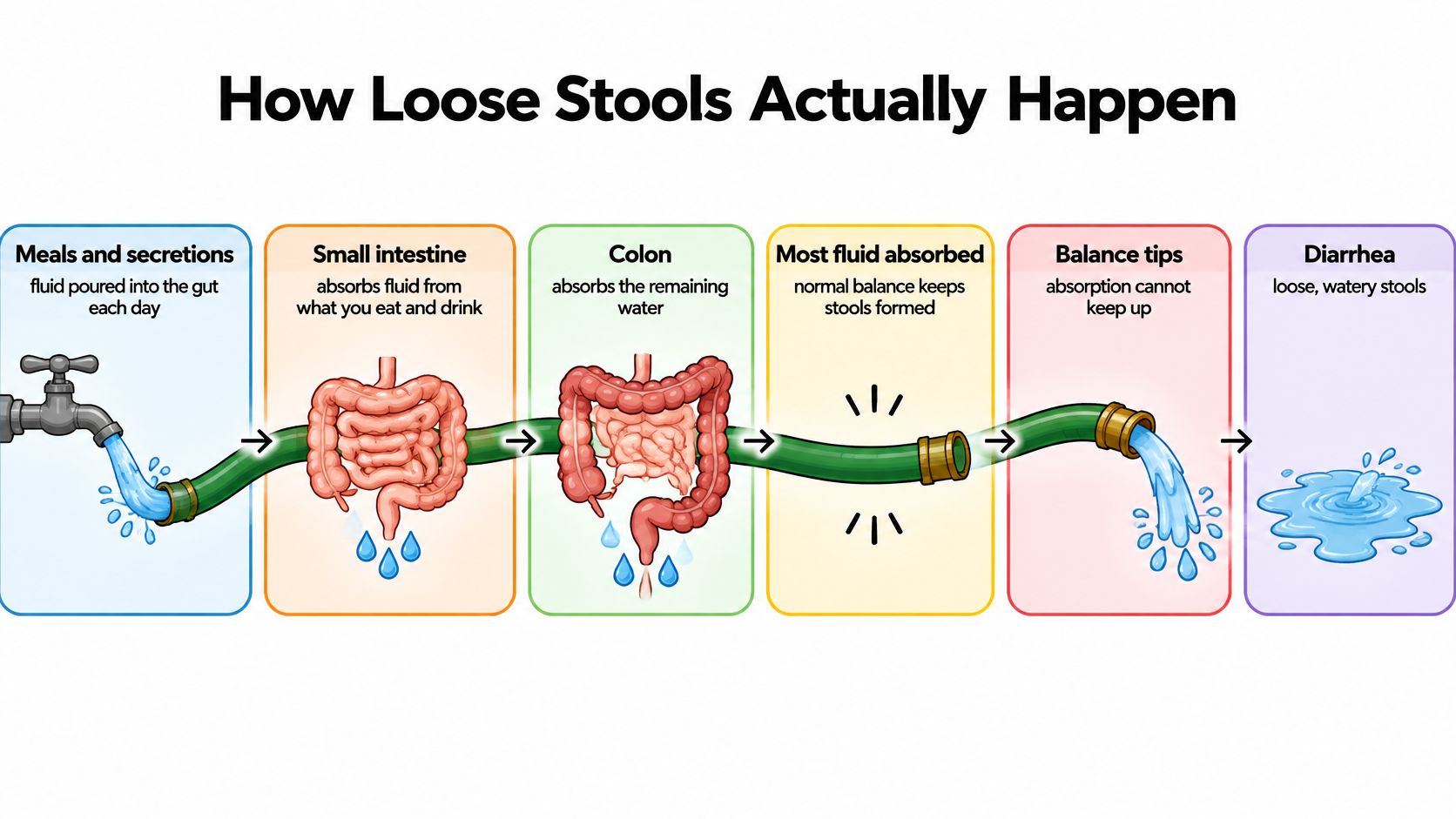
Think of your digestive tract as a garden hose with an absorbent lining. Meals and digestive secretions add fluid along the route. The small intestine absorbs much of it, and the colon takes back remaining water so stool becomes formed.
Diarrhea happens when absorption can't keep up with secretion, unabsorbed material, inflammation, or movement through the gut. This illustration shows the basic balance.
Four Mechanisms Behind Loose Stools
| Mechanism | What changes | Helpful clue | Common triggers |
|---|---|---|---|
| Osmotic | Unabsorbed solutes hold water in the lumen | Often improves when fasting or the trigger stops | Lactose, sorbitol, mannitol, xylitol, magnesium antacids |
| Secretory | Intestine secretes fluid or fails to absorb it | Can continue despite fasting | Bacterial toxins, some medicines, bile-acid related loose stools |
| Inflammatory | Damaged lining leaks fluid, mucus, and sometimes blood | Fever, blood, mucus, or painful urgency | Invasive bacteria or parasites, inflammatory bowel disease |
| Fast transit | Stool moves through before water is absorbed | Urgency soon after meals, smaller volumes | Functional diarrhea, IBS-D pattern, post-infectious change |
Osmotic diarrhea involves substances that remain inside the intestine and retain water. For example, someone who doesn't absorb lactose well may develop gas and loose stools after milk. Sugar alcohols in sugar-free sweets and magnesium-containing antacids can create a similar pattern.
Removing the trigger often helps. That doesn't mean you should stop eating to diagnose yourself. Fasting is a clinical clue, not a recommended home test.
Secretory diarrhea involves active fluid release or impaired absorption. Bacterial toxins can stimulate secretion, while some medicines and bile-acid problems can disrupt normal fluid handling. Because the process doesn't require a recent meal, watery stools may continue when someone isn't eating.
Inflammation and Speed Change the Picture
With inflammatory diarrhea, an injured intestinal lining leaks fluid and may release mucus or blood. Fever and painful urgency increase concern. Tenesmus, the feeling that you still need to pass stool even after trying, can accompany inflammation.
Fast transit means intestinal contents move along before enough water can be absorbed. Someone may notice smaller, urgent stools after meals rather than continuous large-volume watery output. The relationship between movement and stool consistency is explored in this guide to intestinal transit time.
Real illnesses often combine mechanisms. An infection can stimulate secretion, injure the lining, and speed movement at the same time.
Use the helpful clue column to describe your symptoms accurately to a clinician. Don't use it to diagnose yourself or assume that every mechanism responds to the same probiotic, enzyme, or antidiarrheal.
Infectious and Everyday Causes
A sudden household illness and a recurring reaction to dairy can both cause watery stools, but they suggest different next steps. The sequence of events is often more useful than the word diarrhea alone.
Infections tend to fit a recognizable exposure story: sick contacts, contaminated food, travel, or untreated water. Noninfectious causes more often follow a medicine, a particular food, or a longer-running digestive pattern. These clues overlap, so none proves a diagnosis.
Causes a Reader Can Match to a Day
| Cause | Clue | Recognizable situation |
|---|---|---|
| Norovirus or other community virus | Watery stools, nausea, a few days, household spread | Office lunch then vomiting and watery stools at home |
| Foodborne bacteria | Fever or blood added to loose stools | A shared meal followed by more severe illness |
| Parasites | Symptoms that persist, or travel and untreated-water exposure | Stool testing is ordered rather than another wait |
| Antibiotics | Loose stools during the course or shortly after it ends | Severe or post-hospital illness raises concern for C. difficile, not a simple bug |
| Magnesium antacids | Acute osmotic loose stools after the medicine | Stools ease when the antacid stops |
| Lactose or sugar alcohols | Osmotic pattern that eases off the trigger | Dairy or sorbitol, mannitol, or xylitol |
| Celiac disease, pancreatic enzyme shortage, inflammatory bowel disease | Months of loose stools, sometimes with weight loss or blood | Not a short stomach bug |
| Functional diarrhea or IBS with diarrhea | Recurrent loose stools without red flags | Pattern returns between well periods |
A shared lunch followed by vomiting and watery stools among household members makes a contagious infection plausible. It doesn't establish that lunch was the source. Viruses can spread through close contact, and foodborne illnesses can look similar.
By contrast, loose stools that begin during an antibiotic course make medication exposure important. Severe symptoms or recent hospitalization should prompt consideration of C. difficile, rather than an automatic assumption that this is a routine stomach bug.
Repeating Food Patterns Need a Different Question
If symptoms repeatedly follow dairy, ask whether lactose digestion could be involved. A targeted explanation of enzymes for lactose intolerance can help distinguish support for a specific food from a general probiotic for gut health.
Medication users should also separate accompanying symptoms. For someone taking a weight-loss medicine, 10 Rx Home's nausea guidance for weight-loss medication users addresses nausea-related questions, but it doesn't replace evaluation of persistent or severe diarrhea.
Months of loose stools with weight loss shouldn't be treated as a lingering stomach bug or a supplement-selection problem.
Functional diarrhea and IBS with diarrhea can cause recurring symptoms, but that label shouldn't be self-assigned when blood, weight loss, or other warning signs are present. Similarly, antibiotics aren't useful for a typical viral illness and can introduce additional digestive problems.
Red Flags That Mean Stop Waiting
Adults should seek medical evaluation for diarrhea lasting more than two days without improvement, dehydration, severe abdominal or rectal pain, bloody or black stools, or fever above 102°F (39°C), according to Mayo Clinic's diarrhea guidance. These findings change the decision from trying another home remedy to assessing the cause and severity.
Dehydration can appear as excessive thirst, dry mouth or skin, little or no urination, weakness, dizziness, fatigue, or dark urine. If you're faint, confused, unable to keep fluids down, or barely urinating, seek urgent medical help rather than waiting for a routine appointment.
Adult Red Flags and What to Do
| Sign | Why it matters | Next action |
|---|---|---|
| No improvement after more than two days | The illness needs reassessment rather than continued assumptions | Clinical assessment rather than more waiting |
| Fever above the threshold given above | Raises concern for significant infection or inflammation | Same-day medical care |
| Bloody or black stools | May indicate bleeding, invasive infection, or inflammatory disease | Urgent care; don't start antibiotics on your own |
| Severe abdominal or rectal pain | May be more than simple gastroenteritis | Urgent clinical exam |
| Dehydration symptoms | Fluid loss can worsen and impair circulation | Medical care and supervised rehydration when needed |
| Immune suppression, hospital exposure, or recent antibiotics with severe or persistent stools | Raises concern for C. difficile and other infections requiring assessment | Prompt evaluation and stool testing when indicated |
Testing Doesn't Automatically Mean Antibiotics
The adult acute diarrheal infection guideline supports targeted evaluation for concerning presentations, including bloody or febrile diarrhea, moderate-to-severe illness, suspected outbreaks, hospital-associated infection, persistent symptoms, and immune suppression.
A clinician uses your exposure history and symptoms to decide which tests could change treatment. Testing may identify an infection, help avoid an unnecessary medicine, or suggest that a noninfectious explanation deserves attention.
Empiric antibiotics, treatment started before identifying the cause, generally aren't indicated for uncomplicated acute watery diarrhea without recent international travel. Prolonged watery illness also isn't a reason to take leftover antibiotics.
One important exception to the assumption that antibiotics always help bacterial illness is suspected Shiga toxin–producing E. coli. Antibiotics can increase the risk of hemolytic uremic syndrome, a serious complication affecting blood cells and the kidneys. Bloody diarrhea therefore needs a clinician's judgment, not a pharmacy-only decision.
Recent antibiotics or hospitalization should be reported explicitly. They can change which stool tests a clinician considers and whether targeted treatment is necessary.
Mild, brief watery illness without these warning signs is the home-care situation.
Home Care and Where Supplements Fit
Home care is appropriate only when symptoms are mild, brief, and watery, without the warning signs above. Fluid replacement comes before microbiome support.
Keep the basic recovery priorities visible while you're feeling unwell.

Start With Hydration and Familiar Food
- Replace water and electrolytes. Use an oral rehydration solution when stools are frequent. Mix commercial packets with exactly the amount of water stated on the package. If nausea makes drinking difficult, take small, frequent sips rather than large drinks.
- Eat as appetite returns. Choose familiar, easy-to-tolerate foods such as rice, soup, toast, or potatoes. You don't need to force a large meal or fast to stop diarrhea. Temporarily leave out dairy if it clearly worsens symptoms.
- Review avoidable triggers. Set aside sugar-alcohol sweeteners and check whether a magnesium antacid could be contributing. Ask a pharmacist before changing prescribed medicines.
- Don't use leftover antibiotics. They may be ineffective for the cause and can produce additional harm.
Large amounts of juice or soda aren't equivalent to an oral rehydration solution. Their sugar content can aggravate osmotic symptoms, while their electrolyte balance isn't designed for replacing diarrheal losses.
The accompanying video offers another format for reviewing digestive-care information.
Match Supplement Support to a Specific Job
A probiotic may support digestive balance in an appropriate setting, but it doesn't identify the cause of diarrhea. Saccharomyces boulardii is a probiotic yeast discussed in antibiotic-associated diarrhea because antibacterial medicines don't act on it as they do on bacteria. Whether it fits your situation still depends on your health status and the reason for symptoms.
People with immune suppression or serious illness should ask their clinician before taking a live-microorganism supplement. This guide to whether probiotics help diarrhea provides additional context for product comparisons.
As one option, GutRx BALANCE offers 30 billion CFUs per capsule, with next-generation probiotics for gut health, digestive balance, and immune support, according to its product description. That formulation description isn't evidence that it treats an acute infection or replaces rehydration.
When comparing products, look for identified strains, evidence relevant to your intended use, storage instructions, and accessible third-party testing documentation. A higher CFU count alone doesn't establish a better fit.
Digestive enzymes serve a different purpose: helping digest particular meal components. A dairy-focused enzyme isn't a substitute for managing an acute watery illness, and a daily regularity supplement isn't automatically appropriate during a loose-stool episode.
Blood, high fever, or dehydration is a reason to seek care, not to upgrade your supplement.
How Long It Lasts Changes the Next Step
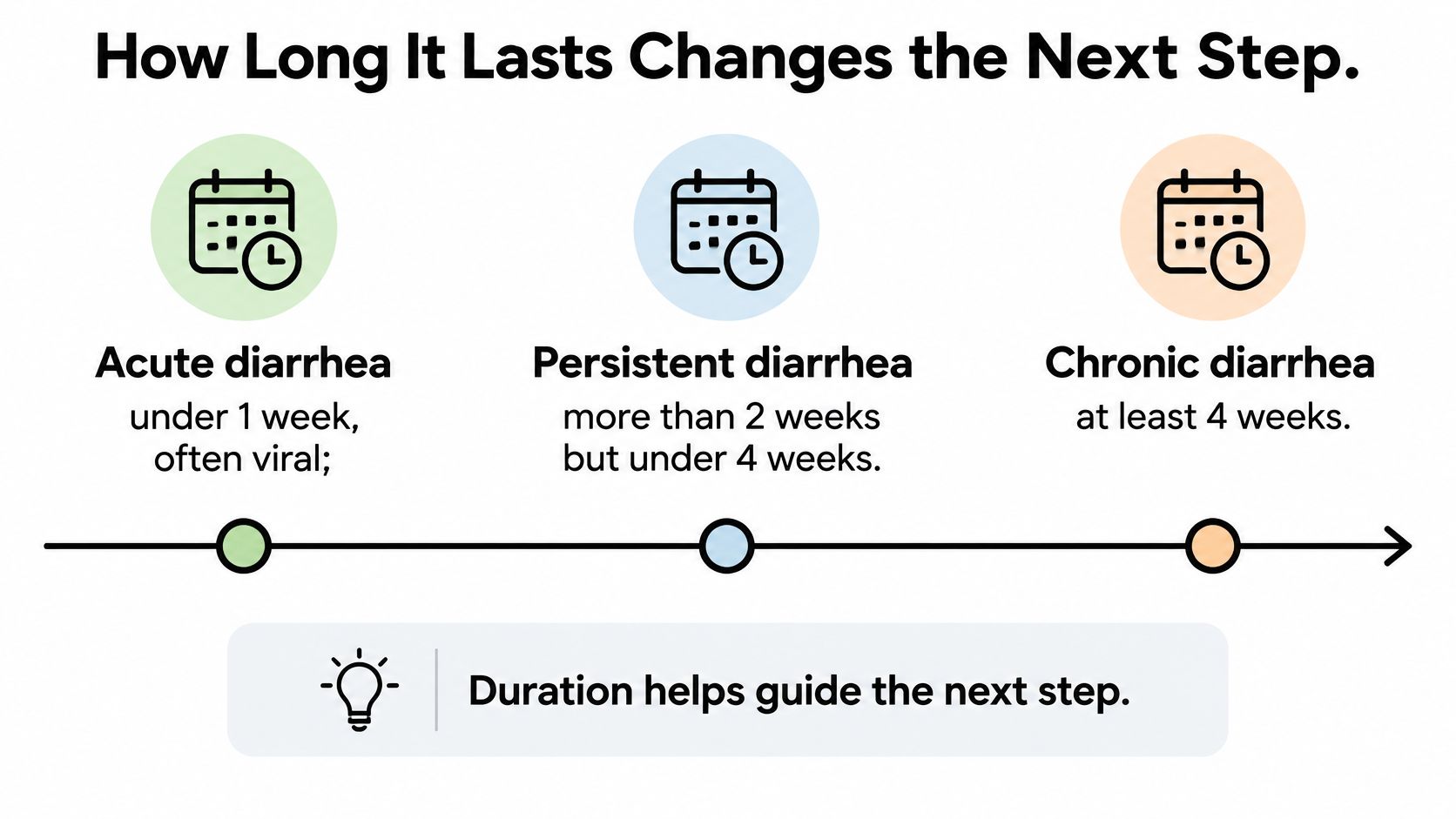
Duration helps distinguish an episode that's resolving from a problem that needs a broader explanation. The National Institute of Diabetes and Digestive and Kidney Diseases describes acute diarrhea as generally lasting less than one week, persistent diarrhea as lasting more than two but less than four weeks, and chronic diarrhea as lasting at least four weeks.
These categories aren't permission to wait through worsening symptoms. A person can need urgent care early in an episode, while someone whose stools are steadily becoming formed may be recovering without a supplement.
The timeline provides a useful framework for discussing duration with a clinician.
The Early Clock Is About Direction
During a brief illness, ask whether you're drinking adequately, urinating normally, and having less watery output. Improvement matters more than whether your digestion feels completely normal immediately.
If you're improving, continue fluids and food as tolerated. Don't add antibiotics or several new supplements just because you haven't returned to your usual bowel pattern. Introducing multiple products also makes it harder to identify what worsens gas, discomfort, or stool consistency.
If you aren't improving, arrange assessment rather than extending home treatment indefinitely. Warning signs override every duration category.
The Weeklong Clock Raises the Testing Question
When symptoms continue toward a week, prepare a useful history instead of assuming the gut only needs more bacteria. Tell the clinician about:
- Exposures: Travel, untreated water, shared meals, sick contacts, and possible workplace or household spread.
- Medicines: Antibiotics, magnesium products, new prescriptions, and supplements.
- Pattern changes: Symptoms that wake you at night, weight loss, blood, fever, or repeated episodes.
- Health context: Recent hospital care and conditions or treatments that suppress immunity.
A clinician can decide whether stool testing, medication review, blood tests, or another evaluation is most appropriate. A test is useful when the result can change management, not just because symptoms are frustrating.
The Longer Clock Broadens the Explanation
Past the persistent-duration boundary, the question becomes larger than whether the original bug remains. Possibilities include ongoing infection, medication effects, inflammation, malabsorption, and altered bowel function after an infection.
Mayo Clinic's antibiotic-associated diarrhea guidance notes that loose stools can begin during antibiotic treatment or shortly after it ends. More serious C. difficile illness may require stool testing and targeted therapy. Finishing the antibiotic course doesn't automatically settle the diagnostic question.
Chronic symptoms widen the possibilities further. Celiac disease, pancreatic dysfunction, inflammatory bowel disease, food intolerance, sugar alcohols, and functional disorders can produce overlapping complaints. Weight loss or nighttime symptoms deserve attention rather than reassurance based on a probiotic response.
Feeling better after a supplement doesn't prove what caused the diarrhea. Likewise, continuing symptoms don't prove that you need a stronger formula.
Recovery-focused digestive support may fit after serious causes have been considered and acute fluid loss has settled. Persistent or recurrent diarrhea needs an explanation first, especially when it interferes with eating, sleep, work, or maintaining weight.
GutRx offers probiotic and digestive-support options for people comparing ongoing gut-health routines after an acute illness has settled. Visit GutRx to review product ingredients and quality information, and choose support that matches your goal rather than using a supplement to delay evaluation of persistent diarrhea.


