

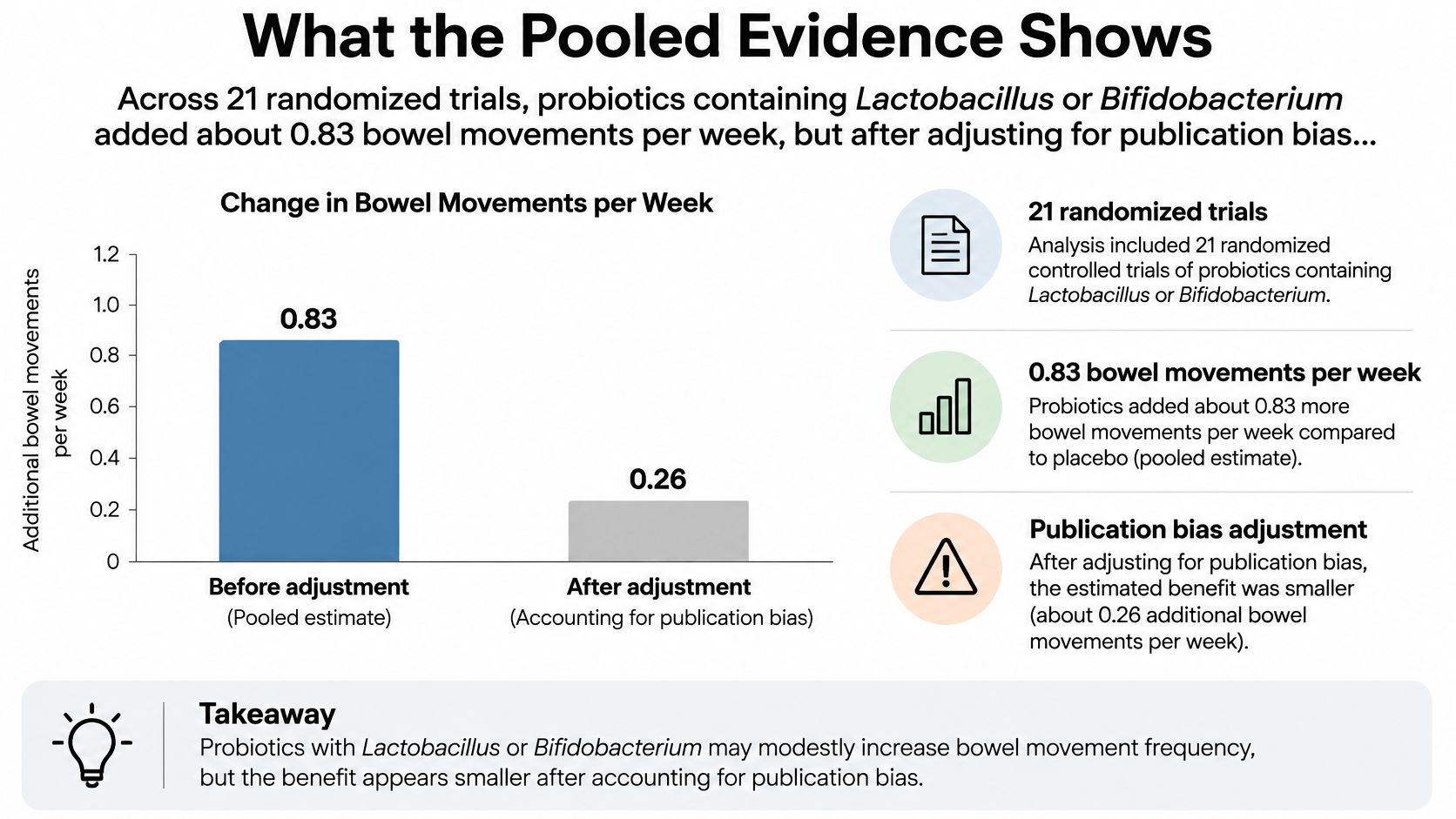
When statisticians adjusted for publication bias in a 2017 meta-analysis, the average gain from products containing Lactobacillus or Bifidobacterium fell from 0.83 extra bowel movements a week to 0.30. The pooled-evidence section below breaks down that correction in detail. It is the strongest single reason no shelf can name one best probiotic for severe constipation.
The defensible claim is narrower: a modest, strain-specific nudge in the right population, and only after serious causes have been screened out. A long species list or a huge CFU count does not inherit another strain's trial result. What matters is matching the named strain, the studied dose, and a trial group that looks like you. Bleeding, weight loss, or signs of obstruction call for medical triage before any product comparison.
Table of Contents
- Quick Picks by Constipation Situation
- When Severe Constipation Needs Medical Triage First
- What the Pooled Evidence Shows
- Synbiotic Pairings and How Probiotics Might Move Stool
- Label Checks That Separate Strong Formulas from Weak Ones
- Run a Four-Week Test Before Buying a Second Bottle
Quick Picks by Constipation Situation
Trial results differ by strain, dose, population, and outcome. These options are comparisons to consider, not a single winner: bowel-movement frequency, transit time, and symptom relief are not interchangeable measures.
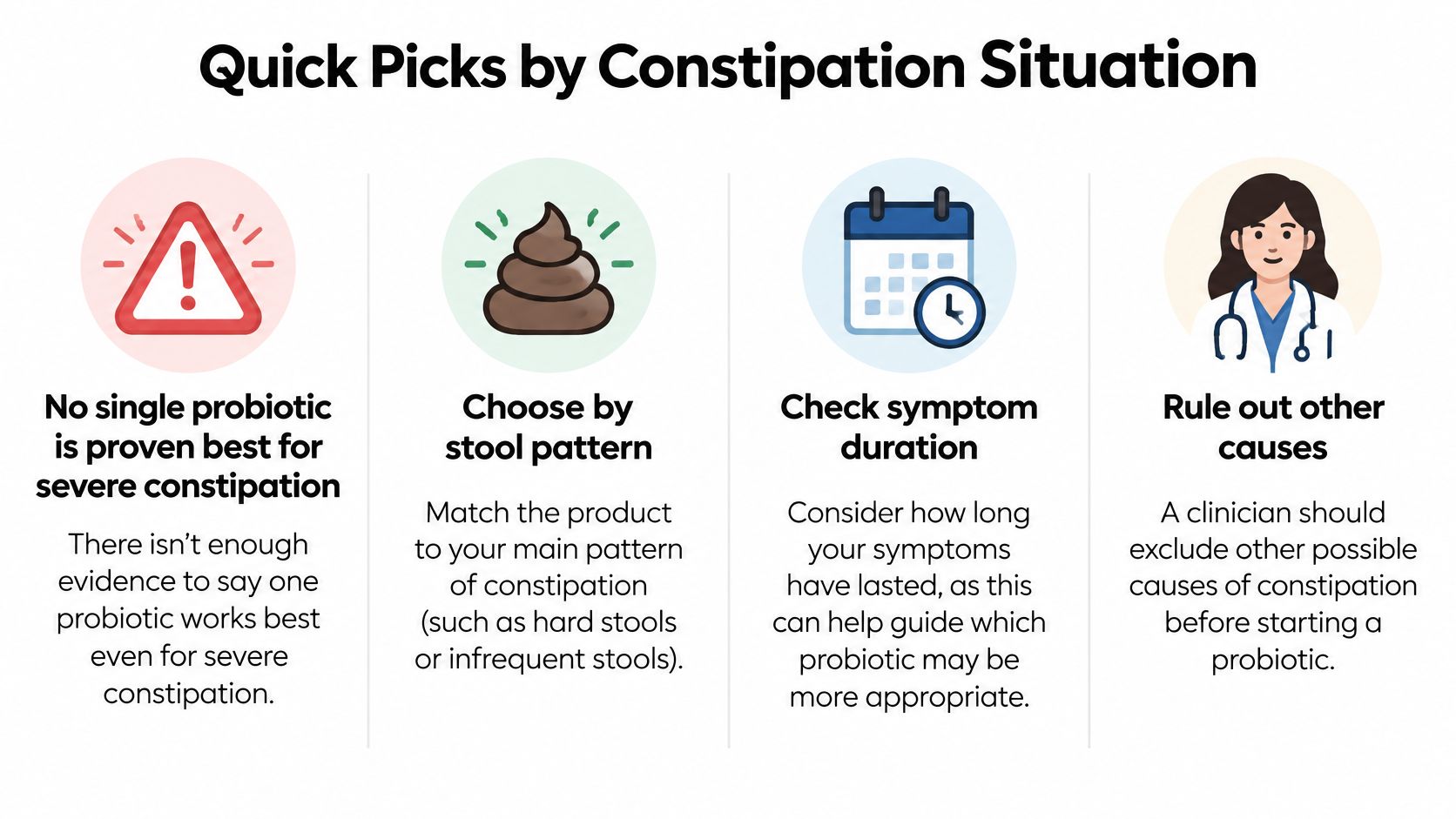
Read each row as one trial, not a category
A result applies to the strain and dose studied. When a trial listing does not report a dose or outcome, the table says so rather than filling the gap with an estimate.
| Situation | Studied option | Population and dose | Reported signal | Main caveat |
|---|---|---|---|---|
| Chronic constipation over 3 months, fewer than 3 bowel movements per week or Bristol types 1-2 | Bifidobacterium animalis subsp. lactis BLa80 | Adults in a 2024 randomized trial in Spain; dose not reported in the trial listing | Outcome numbers not reported in the trial listing | Narrow eligibility; does not generalize to all constipation |
| Low weekly bowel movements, short trial | Bifidobacterium lactis DN-173 010 | Adults in a randomized trial summarized in a systematic review; dose not reported; 2 weeks | 2.5 to 3.5 bowel movements per week after one week; 4.1 vs 2.6 per week at week two | Single trial; confirm the strain on the label |
| Low daily defecation | Lactobacillus casei rhamnosus Lcr35 | Adults in a randomized trial; dose and duration not reported | 0.57 vs 0.37 defecations per day, as reported in the systematic review | Modest difference; confirm population and dose in the original trial |
| Transit-time focus | Bifidobacterium lactis HN019 | 88 adults, triple-blind, 2 weeks; higher and lower doses tested | 28-hour reduction at the higher dose; 19-hour reduction at the lower dose; placebo rose 1 hour, as reported in a review | Later 228-adult double-blind trial found no significant benefit |
| General multi-strain product | Lactobacillus or Bifidobacterium products as a class | 21 trials, 2,656 adults | +0.83 bowel movements per week; +0.30 after publication-bias adjustment, according to a review of the pooled evidence | Class-level result; does not prove any single strain works |
| Medication-induced, IBS with constipation or alarm symptoms | No probiotic-first option | Not applicable | Probiotic evidence does not replace evaluation | Clinician assessment comes first |
The conflict most labels hide
Bifidobacterium lactis HN019 has conflicting trial results. In an 88-person, triple-blind trial, the higher dose reduced whole-gut transit by 28 hours and the lower dose by 19 hours, while transit increased by 1 hour with placebo over two weeks. A later double-blind trial in 228 adults with chronic constipation found no significant HN019 benefit over placebo for transit time, stool frequency, stool consistency, symptoms, or constipation-related quality of life, according to the Proceedings of the Nutrition Society review. That makes HN019 a candidate for a strain-specific trial, not a proven transit remedy. The same review says the American Gastroenterological Association recommends probiotics for adults with IBS only within a clinical trial.
Bifidobacterium animalis subsp. lactis BLa80 was studied in a narrower group than the broad label “constipation” suggests. A 2024 randomized trial listed in a 2025 evidence review enrolled adults in Spain whose constipation had lasted more than three months and who had fewer than three bowel movements per week and/or Bristol types 1–2. That eligibility does not match a newer pattern, softer stools, or mainly incomplete emptying.
The shorter trials also need careful reading. In the systematic review, adults taking Bifidobacterium lactis DN-173 010 averaged 2.5 to 3.5 bowel movements per week after one week, then 4.1 versus 2.6 per week in the control group at week two. The same review reports 0.57 versus 0.37 defecations per day in an Lactobacillus casei rhamnosus Lcr35 trial. These are single-trial signals; an unreported dose cannot be inferred from a product blend.
A review of 15 randomized trials found improvements in spontaneous bowel movements and stool consistency, but no significant improvement in gut-transit time or quality of life, and no consistent advantage for multispecies products over single-strain products. Adding strains does not establish a better match.
Practical rule: Prioritize a named strain and studied dose tested in a population like yours, not a larger CFU count or longer species list. The table helps compare trial signals; it does not determine whether severe constipation is safe to self-treat.
When Severe Constipation Needs Medical Triage First
A probiotic is supportive care only after serious causes are screened. Several common causes are not a missing microbe. Opioids, iron, and anticholinergic drugs slow the bowel. Neurologic disease, metabolic disorders, structural bowel problems, and pelvic-floor defecatory disorders can do the same. A capsule will not reverse those.
The American Gastroenterological Association states that colonoscopy should not routinely be performed in patients without alarm features unless they are due for age-appropriate colorectal-cancer screening. The alarm features it cites include blood in the stool, anemia, and unintentional weight loss. Those three should send you to a clinician before any supplement. Severe or progressive abdominal pain, vomiting, marked distension, inability to pass gas, or a sudden change in bowel habits can point to conditions that need urgent evaluation.
Warning signs and the action to take
| Warning sign | Action |
|---|---|
| Blood in the stool or rectal bleeding | Prompt medical assessment before any supplement |
| Unexplained anemia or unintentional weight loss | Clinician evaluation for alarm features |
| Vomiting, marked abdominal distension, or inability to pass gas | Urgent evaluation; do not self-treat |
| Severe or progressive abdominal pain | Urgent evaluation |
| Sudden change in bowel habits | Clinician visit to rule out structural or systemic causes |
| New constipation in an older adult, or constipation after a new medication | Clinician review of medications and causes |
Split the list by speed. Vomiting, a belly that is swelling, or an inability to pass gas is an urgent-care problem, not a two-week supplement test. Bleeding, anemia, weight loss, a new pattern in an older adult, or constipation that started with a new medicine needs a prompt visit, even if you can still pass gas.
Bring the full medication list and a short symptom log. Note weekly bowel movements, stool form, straining, and any laxative you already use. That record helps a clinician separate a case that might respond to a strain trial from one that needs a different treatment. People comparing home observation with a clinician visit can use at-home care advice for Dubai families as a plain example of when to call rather than wait on a bottle. If the pattern is irregular but free of alarm features, a guide to irregular bowel movements is a reasonable next read after the visit is booked or cleared.
What the Pooled Evidence Shows
Plan around 0.30, the bias-adjusted figure. In a 2017 systematic review and meta-analysis of 21 randomized controlled trials with 2,656 participants, products containing Lactobacillus or Bifidobacterium increased bowel movements by an average of 0.83 per week versus control (95% CI 0.53 to 1.14, P<0.001). Correcting for publication bias cut that estimate to 0.30 extra movements per week, and heterogeneity ran high at I²=85%. The gap between 0.83 and 0.30 is what missing negative trials do to an average.
A later systematic review is larger and still uneven, covering 30 probiotic trials in 2,804 adults. Stool frequency improved, with a standardized mean difference of 0.71 (95% CI 0.37 to 1.04) and I²=91%. Global constipation symptom scores improved by −0.46 (95% CI −0.89 to −0.04, I²=89%). Stool consistency and whole-gut transit time did not reach significance.
Two conclusions matter for a buying decision. Expect closer to a third of an extra bowel movement per week than a full one, because the unadjusted average overstates what a single bottle is likely to do. And with I² between 85% and 91%, the pooled average conceals wide differences across strains, doses, and enrolled populations, so the evidence argues for a strain-level trial rather than a single best product.
Which measures moved
| Outcome | Pooled result | Caveat |
|---|---|---|
| Intestinal transit time, 21 randomized trials | Standardized improvement 0.65 (95% CI 0.33 to 0.97) | The transit gain did not translate uniformly across studies |
| Trials enrolling by formal Rome criteria | Larger benefit than trials that did not | Who gets enrolled changes the pooled average |
| Incomplete evacuation, recent review of 30 trials | Standardized mean difference −0.81 (95% CI −1.17 to −0.45) | The measure most relevant to difficult constipation |
| Stool consistency, same review | Not significant (P=0.08) | Softer stool remains unproven |
| Whole-gut transit time, same review | Mean difference −3.0 hours (95% CI −10.4 to 4.4), not significant | Frequency gains did not prove faster transit |
The pooled numbers justify a monitored trial. They do not justify an expectation of guaranteed relief, and they are not a substitute for established constipation therapy when symptoms are severe.
Synbiotic Pairings and How Probiotics Might Move Stool
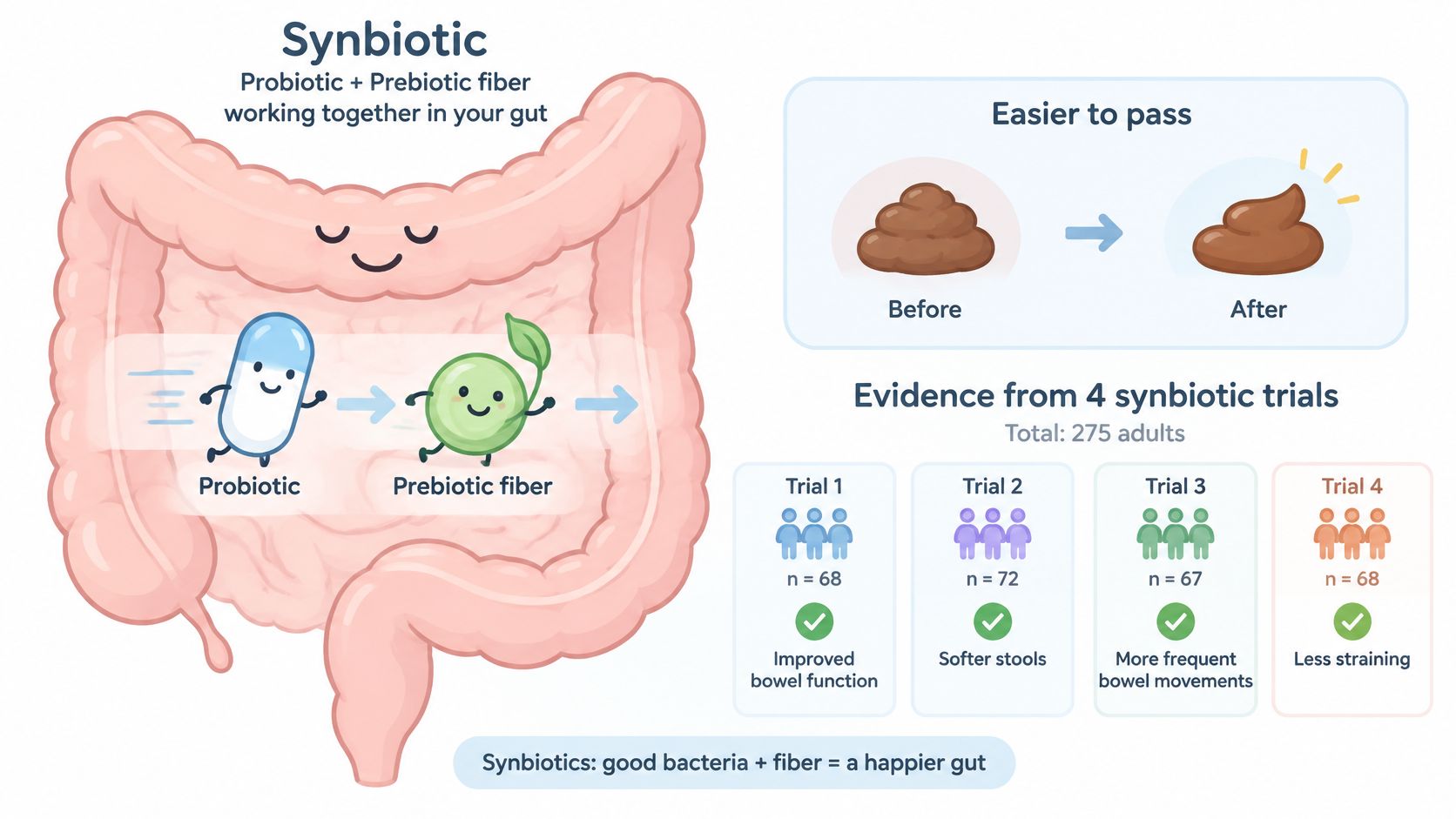
A synbiotic pairs a probiotic with a prebiotic fiber meant to feed it. The evidence is thinner than the label often implies: in the Proceedings of the Nutrition Society review, the synbiotic base is only four trials and 275 adults, far smaller than the probiotic set, so a synbiotic claim is less certain than a strain claim that already has its own trial. That favors testing a named strain first unless stool hardness is the main problem.
Proposed mechanisms are plausibility, not proof that your bottle will work.
- Fermentation: Colonic bacteria may ferment fiber into short-chain fatty acids, which may influence colon motility and how the colon handles fluid.
- Community shift: The added strain and the fiber may change which microbes are abundant. That shift is not the same as a measured bowel-movement gain.
- Stool water: Effects on water content could soften stool. Softer stool still does not prove faster whole-gut transit.
None of those steps establishes a strain-level effect. A mechanism explains why a trial was worth running. It does not replace the trial.
When a pairing fits
If you already tolerate fiber and you have a named strain to test, a probiotic alone is the cleaner experiment. If you need softer stool and you have tolerated prebiotics before, a synbiotic is a reasonable next formula, with the fiber amount printed per capsule. If prebiotics give you gas or bloating, start with a plain fiber step you already know you can finish, then add one strain later. The useful buying distinction is how prebiotics and probiotics together differ from a probiotic-only capsule. Severe pain, blood, weight loss, or a sudden change still belongs in medical triage before either experiment.
Label Checks That Separate Strong Formulas from Weak Ones
A clean label does not prove a clinical effect. In the United States, dietary supplements are not preapproved by the FDA for safety or effectiveness before marketing, and the FDA does not routinely test them before they reach consumers. Manufacturers that make structure/function claims must have substantiation that the claims are truthful and not misleading. That requirement does not make a product an FDA-approved constipation treatment. The FDA's supplement Q&A also notes that consumers may contact the manufacturer or a commercial laboratory for an analysis of contents.
Pre-purchase checklist
| Label item | What to look for | Red flag |
|---|---|---|
| Strain identity | Full genus, species, and strain designation | Only "proprietary probiotic blend" or a genus name |
| Viable count | Count guaranteed through the expiration date | Count stated only at manufacture |
| Certificate of analysis | Lot-specific, third-party tested, methods or standards named | No lot number or no downloadable document |
| Prebiotic content | Named fibers with amounts per capsule | Vague "prebiotic blend" with no amounts |
| Delivery and storage | Delayed-release or shelf-stable format with storage instructions | No storage guidance or no protection claim |
| Warnings and allergens | Immunocompromised, pregnancy, and allergen statements | Warnings missing or unclear |
A higher CFU is not automatically better. The count means something only when the strain is named and the number is guaranteed through expiry. Read the count beside the strain list, not above it. A certificate of analysis should name the tested lot and the methods or standards. Identity, potency, purity, and contamination checks speak to quality. They still do not prove the formula helps constipation unless those strains and doses have human trials.
What third-party tested probiotics should show on a downloadable document is lot identity plus the test method, not a badge with no file behind it. Storage instructions matter because a viable count on the carton fails if the bottle sits in a hot car. Allergen lines and warnings for immunocompromised users are part of the same pass. Missing warnings are a reason to skip the product, not a detail to discover after the first capsule.
Run a Four-Week Test Before Buying a Second Bottle
A written log turns "I think it helped" into a countable result, which matters because the pooled evidence cannot name one winning strain. Run the trial in five steps.
- Log one to two weeks before you start. Record bowel movements per week, Bristol form, straining, incomplete evacuation, bloating, and rescue-laxative use, since a change only counts if you can compare it against your own baseline.
- Start one clearly labeled strain or formula at the studied dose. Don't add another new supplement that changes bowel habits in the same window, or the log cannot assign the effect.
- Reassess at two to four weeks with the same log. A 2024 Cureus review notes a randomized trial lasting 1 month and 12 days that reported gains in complete spontaneous bowel movements and spontaneous bowel movements per week, so four weeks is long enough to expect movement if a strain helps you.
- Call it a signal only if the log moves: more bowel movements per week, stool toward Bristol types 3–4, less straining, fewer rescue doses. A 2025 evidence-based dietary guideline, summarized in a PMC evidence review, concluded that probiotics may raise the likelihood of clinical benefit overall, while the evidence remained insufficient to recommend a specific species or strain for that outcome. Your log decides whether that average benefit reached you.
- Stop and get advice if symptoms worsen, pain stays refractory, or any alarm feature appears.
If the log improves, keep the product and share the record with a clinician. If it does not, switch to a different named strain rather than raising the dose, or move to clinician-directed therapy; the guideline found insufficient evidence for any specific strain, so doubling the same capsule repeats a failed test at higher cost. Any next candidate goes through the same label check: compare the named strains and prebiotic amounts in GutRx Daily, a formula built around regularity, against the label rows, and give GutRx Balance, which targets gut health, digestive balance, and immune support, the identical strain-by-strain read before it earns a test slot.
Some people notice extra gas or looser stool in the first few days. Pause and ask a clinician before pushing through that. Speak with a clinician before you start if you are immunocompromised, have a central venous catheter, are pregnant or breastfeeding, or have a serious illness. Probiotics carry a rare infection risk in those groups.


