

The clearest PHGG benefits in adult trials are lower bloating and gas scores at 6 g/day, not a reliable increase or decrease in bathroom frequency. Stool consistency can improve without changing how often someone goes, so the common advice to take more fiber for regularity misses an important distinction.
Before choosing a powder, decide what you want to change: afternoon abdominal swelling, uncomfortable gas, hard stool, loose stool, or infrequent bowel movements. Those aren't interchangeable outcomes, and a fiber that helps one won't necessarily help all of them.
Table of Contents
- PHGG benefits the trials measured
- What PHGG Is and Who Responds
- Studied Doses and How to Build Up
- Tolerance Limits and When to Stop
- A Normal Day Using PHGG Fiber
- Decide If PHGG Matches Your Goal
PHGG benefits the trials measured
PHGG benefits by outcome in adult studies
| Outcome | What changed | Dose and time | Limit of the finding |
|---|---|---|---|
| Journal-recorded bloating in IBS | Scores fell by −4.1 ± 13.4 with PHGG versus −1.2 ± 11.9 with placebo, P = 0.03, in the randomized, placebo-controlled IBS trial | Started at 3 g/day for one week, then increased to 6 g/day during a 12-week trial | No significant stool-frequency benefit in diarrhea-predominant or constipation-predominant IBS |
| Bloating plus gas score | Scores fell by −4.3 ± 10.4 with PHGG versus about −1.1 with placebo, P = 0.035, in the same trial | 108 of 121 randomized adults supplied sufficient intention-to-treat data | Symptom-score improvement, not a demonstrated change in bathroom frequency |
| Preference versus wheat bran | Treatment success was 60% with PHGG versus 40% with bran; about 50% switched to PHGG versus about 11% in the opposite direction, P < 0.001, in a 188-adult trial | 5 g PHGG versus 30 g bran daily for 12 weeks | Per-protocol analysis found similar improvements in pain and bowel habits |
| Loose stool consistency | Bristol Stool Scale scores improved, while frequency did not, in a clinical review of the study | Three months in 44 adults with frequent loose stools | Improved form does not establish an antidiarrheal effect |
| Gas alongside a set diet | Flatulence decreased 55.6%, abdominal spasms 35%, and abdominal tension 4.7% in the diet-associated study | 5 g/day for 24 weeks in 134 adults following a balanced, calorie-controlled diet | Improvement began within three weeks; this was not a placebo comparison |
| Laxative use in care homes | Lactulose, senna, and total laxative use decreased during weeks three and four in the care-home trial and evidence summary | 5 g/day in 200 mL water for four weeks | Bowel frequency and stool characteristics did not significantly outperform placebo |
| Frequency in healthy adults | A review of seven studies involving 325 healthy participants associated 5–7 g/day with improved constipation-related defecation frequency | 5–7 g/day across the included studies | No adverse events were reported in the included studies; this does not establish an instant laxative effect |
The first two rows show the clearest signal: lower bloating and gas scores during a 12-week IBS trial, without a significant change in stool frequency. The published trial report also notes that participants receiving PHGG started with higher abdominal-pain, gas, and total-severity scores, a limitation to keep in mind when interpreting the results.
Keep the outcome that matches your goal
A lower symptom score does not mean symptoms disappeared, and it does not tell you whether someone went to the bathroom more often. The trials measured different outcomes in different groups, at different doses and over different periods. Treat each result as a separate piece of evidence, not a promise that PHGG will address every digestive complaint.
Food choices are another part of a broader meal plan. For comparing rice, breads, and other staples, DietOwl's glycemic index of common Indian staples is a separate food resource, not evidence that PHGG changes a meal's glycemic effect.
These are findings about PHGG as an ingredient, not proof that a finished supplement treats IBS. Ongoing or severe symptoms warrant medical assessment rather than repeated fiber experiments.
What PHGG Is and Who Responds
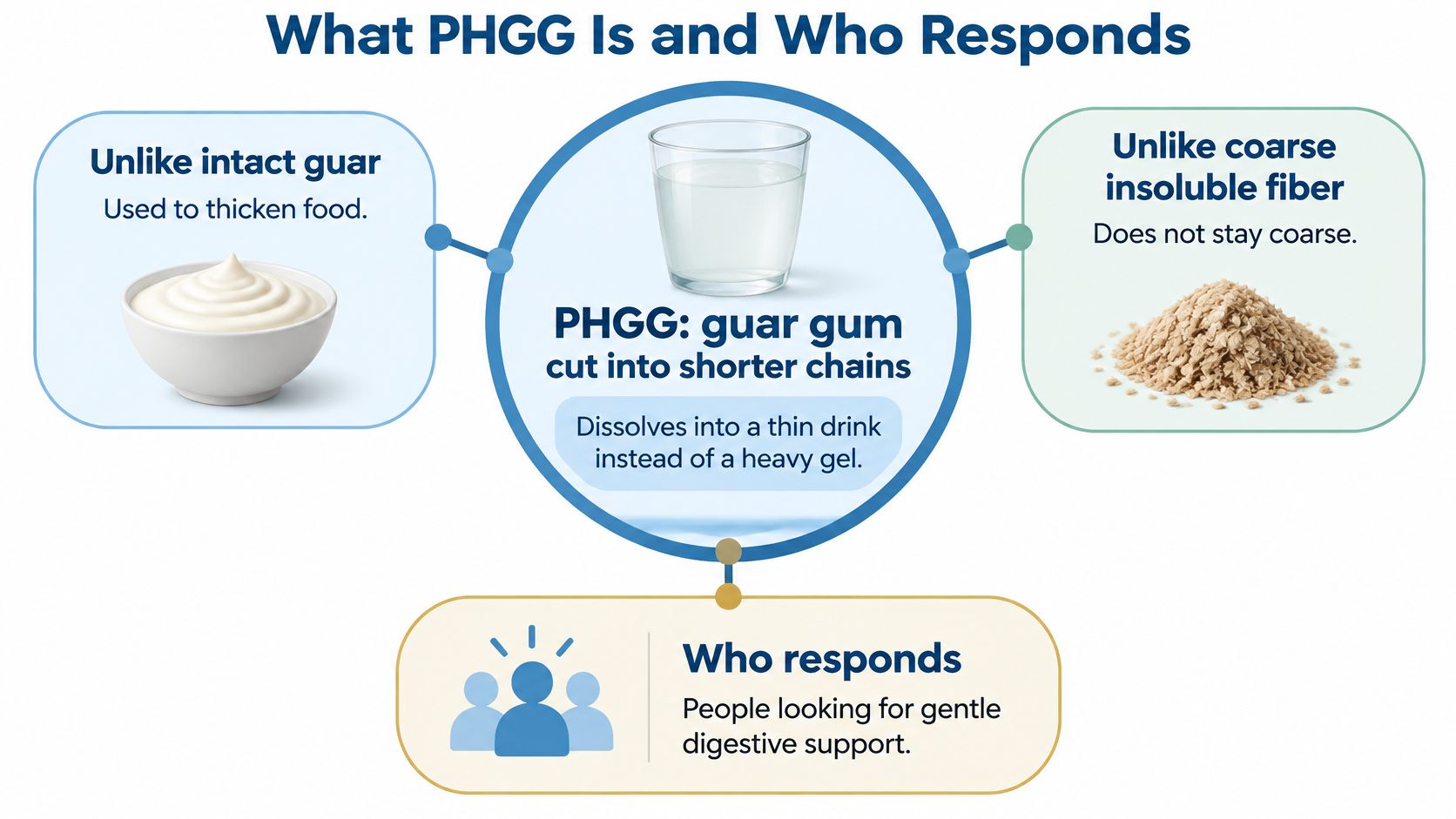
Partially hydrolyzed guar gum, or PHGG, is guar gum processed into shorter chains. That change allows it to dissolve into a thin drink rather than forming the thick gel associated with intact guar gum.
Intact guar is used to thicken food; PHGG adds soluble fiber with little change to a drink's texture. Coarse insoluble fiber behaves differently, contributing physical bulk rather than dissolving.
How gut bacteria use PHGG
PHGG is a fermentable prebiotic fiber. Intestinal microbes can use it as food, and the clinical discussion of PHGG fermentation describes reported increases in Bifidobacterium and Lactobacillus, alongside production of short-chain fatty acids such as acetate, propionate, and butyrate. These fermentation products can affect colon-cell energy supply, water handling, and communication between microbes and the body.
That process may help explain why PHGG's effects could extend beyond adding bulk. Water retention, microbial biomass, and changes in the intestinal environment may help soften hard stool or make loose stool more formed. A plausible mechanism, though, does not guarantee a noticeable change.
Fermentation can also produce gas. A fiber studied for bloating can still cause gas at first if the amount increases faster than a person tolerates it. Easy mixing describes texture, not how the gut will respond.
For a broader guide to prebiotic fiber supplements, compare how fermentable fibers differ from other digestive supplement ingredients.
Preference favors PHGG, but doesn't prove superiority
The multicenter randomized PHGG-versus-bran trial enrolled 188 adults with chronic IBS, including 139 women and 49 men, with a mean age of approximately 40 years. Participants had diarrhea-predominant, constipation-predominant, or mixed patterns.
Among participants who completed their assigned intervention, abdominal pain and bowel habits improved with either fiber, without a clear between-group winner. The results support considering acceptability and tolerability when choosing a fiber; they do not establish that PHGG works better for every symptom.
Practical details can affect whether a fiber is comfortable to use. PHGG's thin texture makes it easier to mix into drinks than intact guar gum, but the fermentable fiber can still cause gas. How much a person uses and how quickly they increase it can shape that experience.
Adults with bloating or gas, or stool that alternates between hard and loose, can consider PHGG as one option. Track each outcome separately:
- Bloating: How swollen or uncomfortable does your abdomen feel?
- Gas: Is passing gas less troublesome, regardless of abdominal size?
- Stool form: Is stool hard and pellet-like, formed, or loose?
- Frequency: How often are you going, recorded separately from comfort?
PHGG is not a diagnostic tool. A response, or lack of one, cannot identify the cause of symptoms.
Studied Doses and How to Build Up
A scoop does not always equal a dose of PHGG. Pure PHGG and blended fiber products have different ingredient amounts, so compare the grams of PHGG on the label with the amounts used in ingredient studies.
For adults using pure PHGG, start with a measured amount and increase only as tolerated.
A practical step-up approach
-
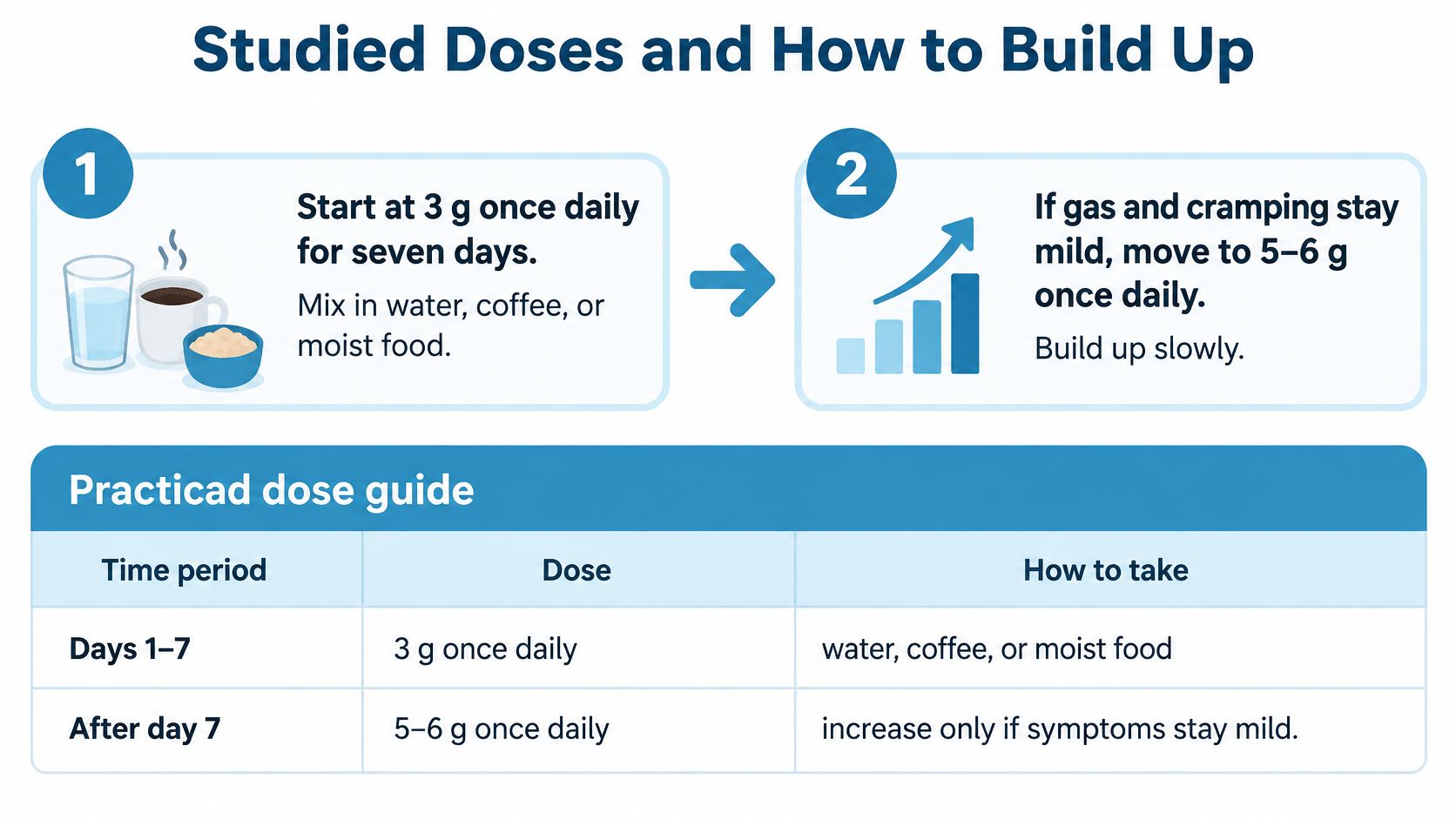
Begin with a small measured amount. A practical starting point is 3 g once daily for seven days, matching the introductory approach used in the bloating trial. Mix it thoroughly into water, coffee, or moist food rather than swallowing dry powder.
-
If gas and cramping remain mild, move toward 5–6 g once daily, the range used in the principal bloating and bran comparisons. Let your comfort guide the pace rather than increasing on a fixed schedule.
-
Use a higher dose only if the lower one has stopped working. A 12-week clinical study evaluated 5 g/day in 46 people and 10 g/day in 40 people with IBS. Both groups improved after the first month, including in gastrointestinal symptoms, quality of life, and distress-related measures.
-
Mix the powder fully with liquid. For pure PHGG, the care-home preparation in the benefits table provides a water-mixing reference. A blend containing psyllium may thicken differently, so follow its preparation directions.
-
Keep the routine steady while judging the result. Use the same time of day and record bloating, gas, and stool form over several weeks. Avoid changing several supplements at once, so you can better judge which change may have helped or caused discomfort.
Judge continued usefulness, not just the first response
In the dose-comparison study, benefits were less pronounced six months after treatment ended, according to the 12-week clinical study. The finding suggests that improvements may depend partly on continuing supplementation rather than reflecting a permanent change.
The care-home and healthy-adult rows in the benefits table show why dose alone does not predict the result. Participants, starting bowel habits, and measured outcomes differed across studies.
A comfortable, useful dose is a better target than the highest dose you can tolerate. If a lower amount is helping, there is no automatic reason to increase it. If symptoms worsen, stop increasing and prioritize comfort.
Tolerance Limits and When to Stop
PHGG's low viscosity describes how it mixes in a drink; it does not guarantee freedom from intestinal discomfort. A rapid increase may bring temporary gas, bloating, or cramping. In the placebo-controlled trial of PHGG for bloating, researchers reported no significant PHGG-related side effects. A review of studies in healthy adults likewise reported no adverse events, though those findings cannot predict how every person will respond.
Your starting microbiome may matter
A review of PHGG research describes a 2023 study in which 40 adults took 10 g daily for three months. Participants whose baseline Shannon diversity index was at least 3 showed greater improvement in IBS symptoms and quality of life, and better tolerance, than participants with lower scores. This is preliminary evidence about possible differences in response, not a validated way to select a dose.
A commercial microbiome test is not needed to decide whether to try PHGG. Response may reflect microbial ecology, the amount taken, or the symptoms being treated, and the study cannot identify the reason for an individual's response. For context on how fermentable ingredients may affect comfort, read about fiber gummies and gas.
Active inflammation changes the conversation
The 2025 mouse study of PHGG and colitis found worse inflammation and tumor outcomes in animals with experimentally induced colitis, while healthy mice were not harmed. Animal findings do not establish what happens in people, but they support getting medical guidance before using isolated fiber with active intestinal inflammation.
Speak with a clinician in these situations:
- Known inflammatory bowel disease: Ask before starting isolated fiber, particularly during active symptoms.
- Bleeding or systemic symptoms: Seek assessment for blood in stool, unexplained weight loss, fever, or pain that wakes you.
- Pregnancy or swallowing difficulty: Get individualized advice before adding a powder.
- Previous bowel obstruction: Get medical guidance before trying fiber.
- Severe symptoms: Stop and seek care if abdominal pain, vomiting, or constipation becomes severe.
The trials discussed here enrolled adults. Children and teens should get pediatric advice before using PHGG; adult amounts are not pediatric dosing instructions.
A Normal Day Using PHGG Fiber
PHGG works best as part of a steady routine, not as a same-day fix. Use a measured amount with a meal that fits your day, then track the symptom you want to change.

Breakfast with afternoon distension
An adult who often feels swollen by late afternoon mixes their usual amount into breakfast coffee. That evening, they record bloating and gas separately, along with stool appearance. A simple entry might read: “Bloating, 4/10; gas, 2/10; stool, unchanged.”
One comfortable evening is a snapshot, not a verdict. Look for a pattern across days, and avoid changing several major parts of your diet at once.
Pure PHGG can be mixed into water, coffee, oatmeal, yogurt, or soup. Stir it through thoroughly. A blend containing other fibers may have a different texture.
Lunch with unpredictable stool form
Someone who alternates between hard pellets and loose stools takes a tolerated amount with lunch, a meal they reliably eat at home. They note whether passing stool feels easier and whether its form is more consistent. Bowel-movement frequency is only one measure of response.
If a day is missed, resume the usual amount rather than doubling the next serving. For travel, pre-portion the tolerated amount in a clean, labeled container and follow the product's storage instructions.
Dinner with beans
A bean-heavy dinner can still bring on sudden gas. Record the meal and symptoms separately from the daily fiber routine, so one uncomfortable dinner doesn't obscure the broader pattern.
An enzyme for particular food carbohydrates and a prebiotic fiber do different jobs. More morning powder may not address every meal-related symptom.
- Keep food first: Use a supplement to add fiber, not to replace a varied diet.
- Keep the basics steady: Maintain your usual fluids and movement while you track changes.
- Review the pattern: Compare your notes across days, including symptom ratings, meals, and stool form.
Decide If PHGG Matches Your Goal
PHGG is a better fit for readers focused on bloating, gas, or increasing daily fiber than for those expecting a predictable change in bowel-movement frequency. Adults without warning signs can assess whether it helps by tracking the symptom they want to improve and how well they tolerate it.
Read the ingredient panel before choosing a product. Check how much PHGG it provides, whether it includes other fibers, and whether its preparation directions fit your routine.
Choose the formula without borrowing a trial claim
GutRx FIBER+ is an unflavored digestive fiber powder designed to increase daily fiber intake and support regularity and satiety. Each 8 g serving contains 3.5 g PHGG, alongside acacia fiber, green banana starch, psyllium husk powder, baobab fruit powder, L-glutamine, and zinc carnosine. Because it combines ingredients, pure-PHGG trial amounts are not its serving instructions, and ingredient studies do not establish the finished formula's effects. These statements have not been evaluated by the FDA. This product is not intended to diagnose, treat, cure, or prevent any disease.
FIBER+ is third-party tested and made in a GMP-certified facility. It is non-GMO and free from artificial additives, gluten, dairy, soy, and major allergens. The 90-day money-back guarantee allows customers who are not completely satisfied with their results to return their order within 90 days for a full refund, with no questions asked. Testing and a return policy can inform a purchase, while your own symptom response determines whether the product suits you.
Frequently asked questions
Do I need a probiotic with PHGG?
No. A probiotic is optional, and the ingredient evidence discussed here does not establish that adding one amplifies PHGG's effects. Assess a combination on its own evidence rather than assuming more ingredients mean better results.
Can PHGG help loose stool without reducing bathroom trips?
Yes. The adult evidence described in this article distinguishes stool form from frequency: stool may become more formed even when bathroom trips do not change. Persistent loose stool still deserves assessment.
Should I keep increasing the amount if nothing changes?
Not automatically. Check whether you have used a consistent, tolerated amount and tracked the symptom you wanted to change. Then discuss alternatives rather than treating the highest studied amount as a target.
When should I skip the supplement experiment?
Seek medical advice first for bleeding, unexplained weight loss, fever, nighttime pain, known inflammatory bowel disease, swallowing difficulty, or possible obstruction. Severe pain or vomiting calls for prompt care, not another serving.
For broader everyday strategies, read our guide to natural approaches to bowel regularity. Choose based on your symptom, tolerance, and ability to maintain a routine.
GutRx FIBER+ offers a blend of fibers for daily fiber intake, with third-party testing and a 90-day money-back guarantee. Visit GutRx to review the current label and preparation directions, then choose a measured routine based on your goal.


