

What separates one women's probiotic from the next?
Three things: the strain inside, the route it takes, and the outcome it was tested for. A bigger CFU count settles none of them. The research behind pre and probiotics for women was built the same way: each study tested named strains, delivered by a set route, against a single clinical outcome in one setting.
That lens changes how you read a label. A capsule can list billions of CFU and still be the wrong match for vaginal balance, urinary comfort, or gas after meals. And a result from one concern does not carry over to the next. A strain studied for vaginal use says nothing about digestion until someone measures it there. Digestive comfort, vaginal balance, and urinary comfort each deserve their own evidence check. When any of the three pieces is missing from a label, you are guessing.
Table of Contents
- Prebiotics and Probiotics Compared at a Glance
- What Research Shows for Vaginal and Urinary Concerns
- What Research Shows for Digestive Comfort
- How to Read a Women's Probiotic Label
- How to Start a Prebiotic and Probiotic Safely
- Choosing a Women's Formula for Your Goal
- Confirm Your Plan With a Clinician Before You Buy
Prebiotics and Probiotics Compared at a Glance
A single women's capsule can hold a fiber, a live culture, a microbial byproduct, or all three at once. The garden version: probiotics are seedlings, prebiotics are the fertilizer that helps them take root, and postbiotics are what the plants give off as they grow. A synbiotic packs seedlings and fertilizer together. A label that only says "prebiotic and probiotic" still tells you little until the strains and fibers are named.
| Term | What it is | Common examples | Where it appears in GutRx products |
|---|---|---|---|
| Prebiotic | Fiber that feeds beneficial bacteria | FOS, GOS, inulin | GutRx DAILY pairs its strains with a 400 mg prebiotic blend |
| Probiotic | Live microorganisms taken in adequate amounts | Lactobacillus and Bifidobacterium strains | GutRx WOMEN'S carries live cultures; DAILY uses 10 strains at 61 billion CFU |
| Postbiotic | Compounds microbes produce during their activity | Tributyrin and other microbial metabolites | WOMEN'S includes postbiotics beside cranberry |
| Synbiotic | Probiotic and prebiotic in one product | A named strain paired with a named fiber | DAILY follows this pattern in one capsule a day, refrigerated after opening |
GutRx WOMEN'S shows how the pieces can share one product. Live probiotic cultures cover the seedling side, postbiotics cover the microbial-compound side, and cranberry is the botanical piece, aimed at urinary wellness within the same formula.
Practical rule: For a vaginal or urinary goal, choose by strain and route, the way the trials did. For more daily fiber alone, a prebiotic can be enough.
CFU counts live organisms in the bottle. It never scores whether those strains match your concern, so a higher number can still be the wrong product for a vaginal goal even when it is a reasonable digestive one. Two bottles can share a Lactobacillus name and differ in strain code, fiber dose, and whether you swallow a capsule or use a vaginal product.
What Research Shows for Vaginal and Urinary Concerns
Read every row below as a closed case. Each study tested specific strains, a specific route, and a specific clinical setting. A result doesn't transfer to another product just because the label also says Lactobacillus.
Lactobacillus species help keep the vaginal environment weakly acidic. A systematic review and meta-analysis of vaginal probiotic studies reported that supplementation significantly reduced vaginal pH, with an odds ratio of 0.36 and a 95% confidence interval of 0.15–0.89, while the same analysis found no statistically significant improvement in IL-4, IL-6, IL-10, TNF-alpha, or the Nugent score used in bacterial vaginosis assessment, according to that vaginal probiotic meta-analysis. One marker can move while the broader picture stays flat.
What Each Concern Tested
| Concern | Strain or route studied | Reported result | Study type |
|---|---|---|---|
| Bacterial vaginosis alongside metronidazole | L. rhamnosus GR-1 and L. reuteri RC-14, given with metronidazole; delivery route not stated in the trial summary | Higher cure rate than placebo at day 30 | Randomized adjunct trial |
| Recurrent UTIs | Vaginal probiotic; strain names not reported for this trial | Fewer symptomatic UTIs and longer time to first recurrence than placebo | Randomized trial in premenopausal women |
| Recurrent vulvovaginal candidiasis | No strain identified as useful for prevention | Probiotics not useful for prevention | 2025 review |
| HPV-related outcomes | Lactiplantibacillus plantarum Probio87 for 12 weeks | Increased beneficial Lactobacillus signals; preliminary | 2025 randomized study |
In the bacterial vaginosis trial, 125 premenopausal women received metronidazole plus either L. rhamnosus GR-1 and L. reuteri RC-14 or placebo. At 30 days the reported cure rate was 88% versus 40% (P < 0.001), and vaginal Lactobacillus recovery was 96% versus 53%, as summarized in this adjunct-probiotic trial report. The probiotic worked as an add-on to the antibiotic.
The urinary row asks a different question. In a randomized trial of premenopausal women with recurrent urinary tract infections, vaginal probiotic treatment reduced symptomatic UTIs and stretched the time to the first recurrence compared with placebo. A separate double-blind study evaluated intravaginal Lactobacillus crispatus in premenopausal women after a urinary infection. The strains and routes differ across these trials, so each result belongs to its own row.
A 2025 review of gynecologic probiotic use found that probiotics may help prevent recurrent bacterial vaginosis when used with or after antibiotics, and that they don't appear useful for preventing recurrent vulvovaginal candidiasis. Reduced recurrent urinary infections in that review showed up inside a broader non-antibiotic bundle that included D-mannose and cranberry, rather than from probiotics alone. The authors said more research is needed before anyone recommends specific strains or products for each gynecologic indication.
The HPV row is narrower still. A 12-week randomized study of a single strain, Lactiplantibacillus plantarum Probio87, reported more beneficial Lactobacillus signals and fewer Streptococcus and Candida signals. That's a preliminary shift in signals, not proof that a probiotic treats an infection.
Diagnosis and prescribed care come first. A supplement doesn't replace testing or an antibiotic your clinician has already chosen.
If you're sorting the recurrence literature, this overview of probiotics for BV prevention keeps prevention research separate from treatment. When a culture names an organism you didn't expect, understanding Pseudomonas in healthcare settings shows why lab identification belongs with your clinician, not with a guess from a bottle.
What Research Shows for Digestive Comfort
Digestive results sit in their own evidence bucket. A probiotic that eased bloating in an IBS trial says nothing about what the same capsule does vaginally, and the reverse is just as true.
In pooled trials, probiotics showed a modest effect on bloating and gas. A Canadian Association of Gastroenterology IBS guideline review pooling 24 probiotic studies found a modest but statistically significant reduction in bloating versus placebo, with a standardized mean difference of −0.13 (95% confidence interval −0.24 to −0.02). Across 11 studies of flatulence, probiotics also lowered gas scores, with a standardized mean difference of −0.23 (95% confidence interval −0.38 to −0.08).
The same analysis found no statistically significant improvement in urgency. The benefit depends on which symptom you are tracking, so a product that helps gas may leave bowel urgency untouched.
Prebiotic fermentation can increase gas or bloating, especially if you have constipation, visceral hypersensitivity, or poorly tolerated fermentable carbohydrates. Research on how probiotics affect visceral hypersensitivity and inflammatory markers is still developing, and no single formulation works for every person with IBS.
The American College of Gastroenterology SIBO guideline summarizes a meta-analysis in which probiotics were associated with reduced hydrogen production (odds ratio 1.61, 95% confidence interval 1.19 to 2.17) and notes that the underlying studies were mostly small and of poor quality. It also cites a controlled report linking probiotics with possible SIBO and D-lactic acidosis, with gas and bloating that resolved after withdrawal and antibiotic treatment. Persistent or unexplained bloating needs a clinical evaluation, not another self-started bottle.
Match the formula to the digestive goal, and keep the claim modest:
- Bloat + Gas is a targeted formula for gas and bloating after trigger foods, and it can be paired with a daily probiotic when you want both.
- Mealtime is a digestive enzyme blend for protein, fat, fiber, dairy, and FODMAP digestion. Enzyme-based formulas work within the same meal, which makes them the right tool when a heavy plate is the trigger.
- DAILY is a 61 billion CFU probiotic plus prebiotic synbiotic for everyday regularity and the occasional bloating that comes with it, taken as one capsule a day.
These statements haven't been evaluated by the Food and Drug Administration. For a plain walk-through of timing and comfort, see how probiotic supplements support digestion and reduce bloating.
How to Read a Women's Probiotic Label
Two bottles can advertise the same CFU count and share nothing else. CFU is a headcount: it says how many bacteria are in the capsule, not which species they are, which route they were studied by, or which outcome they produced. Six checks on the label matter more than the number on the front.

- Strain names. You want genus, species, and a strain designation, such as L. crispatus. The vaginal and urinary trials worked at strain level, so a genus alone isn't that trial. When a label stops at "Lactobacillus blend," you can't match it to any study.
- CFU through expiry. Prefer a count guaranteed through the expiry date when the label says so. A number "at manufacture" can be higher than what's alive on the day you open the bottle.
- Route. An oral capsule and a vaginal product were studied separately, and swallowing one doesn't reproduce the other. The same caution applies across concerns: a strain studied for digestion hasn't been tested for vaginal or urinary outcomes.
- Named add-ins with printed doses. A women's formula may add cranberry or a postbiotic alongside the strains. Whatever the extra is, it needs a dose in milligrams on the label. If the dose isn't printed, you can't compare it to the amounts used in research.
- Testing you can download. Look for third-party testing and a certificate of analysis you can download. A COA confirms purity, potency, and strain identity, so it carries more weight than a quality claim on the front panel.
- Storage. Some live-culture formulas need refrigeration after opening while enzyme products are typically shelf stable. Read the storage line before you travel with a bottle, because heat is hard on live bacteria.
A short video on reading live-culture labels is worth a look before you compare two women's bottles side by side.
Apply the same strain-level check to any women's formula. Here is how the strains in GutRx WOMEN'S line up against the research:
| Strain | Research context | In GutRx WOMEN'S |
|---|---|---|
| Lactobacillus crispatus | Dominant species in healthy vaginal ecosystems; used intravaginally in urinary research | Included, three strains |
| Lactobacillus rhamnosus | Studied as strain GR-1 in a BV adjunct trial | Included; species listed, not identified as GR-1 |
| Lactobacillus reuteri | Studied as strain RC-14 in the same BV adjunct trial | Included; species listed, not identified as RC-14 |
| Lactobacillus acidophilus | Well-studied Lactobacillus species | Included |
| Lactobacillus salivarius | Lactobacillus species studied in women's and digestive research | Included |
| Bifidobacterium breve | Bifidobacterium species used in digestive and women's formulas | Included |
The word probiotic alone guarantees no outcome, and a strain that isn't named on the label can't be assumed to be inside. Keep vaginal, urinary, and digestive evidence in separate boxes, because a result in one concern doesn't transfer to the others. If regularity rather than a women's blend is the main goal, GutRx DAILY combines 61 billion CFU across 10 named strains with a 400 mg prebiotic blend in one capsule a day.
How to Start a Prebiotic and Probiotic Safely
The most common mistake is starting several products or fibers in the same week. Then you can't tell which change caused the symptom.
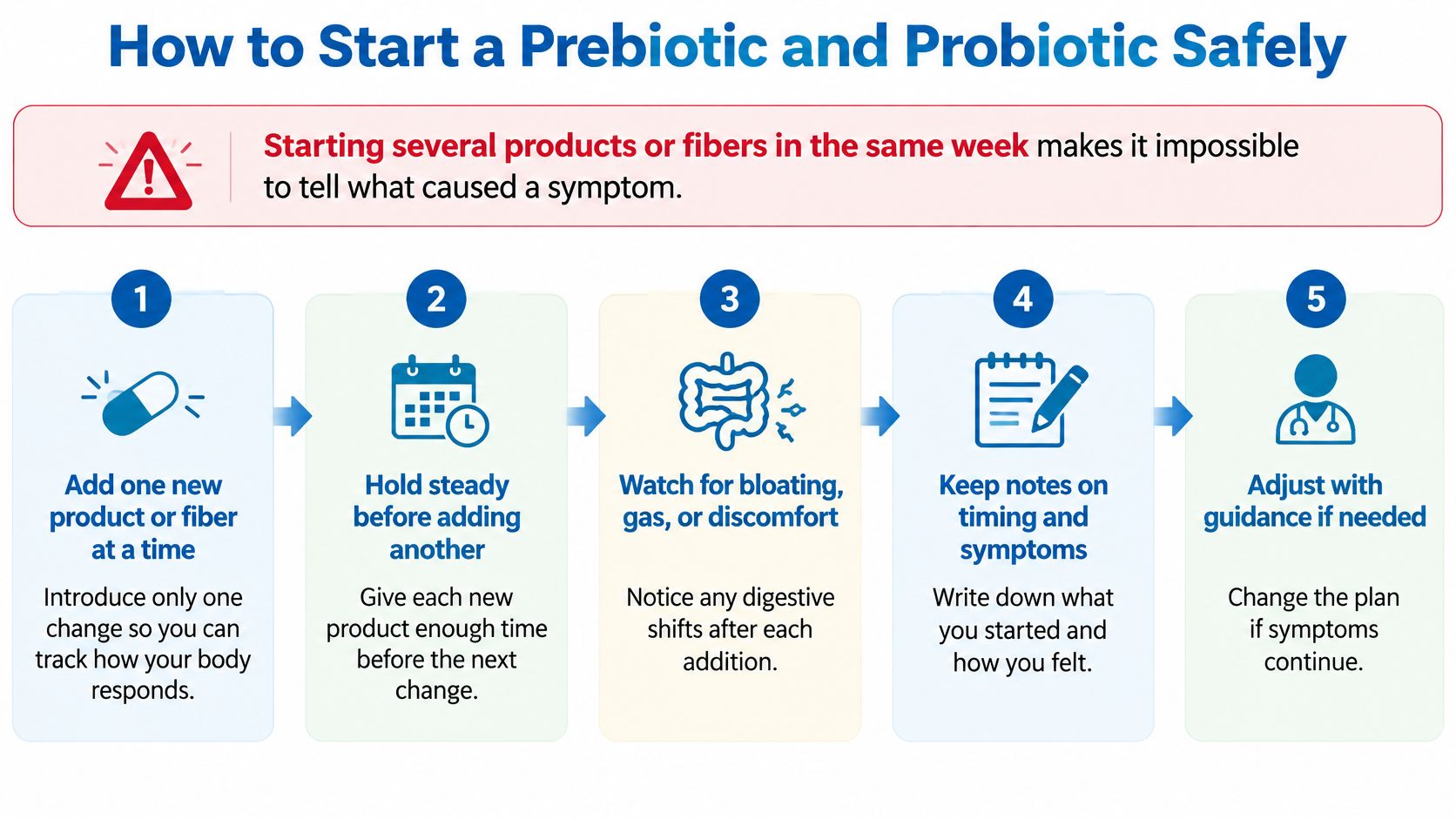
- Add one new product or fiber at a time. Hold it until your log shows how you respond. A second change on day three erases the experiment.
- Start at the label dose. If you add a separate prebiotic fiber, begin with a small amount. Fermentation can increase gas or bloating, particularly with visceral hypersensitivity, constipation, or poorly tolerated fermentable carbohydrates, and a 2025 evidence-based IBS update doesn't establish one formulation for every person. Our guide to prebiotic fiber supplements covers how those fibers differ.
- Take it at the same time each day. For a daily product such as GutRx WOMEN'S, pick a fixed anchor like breakfast and follow the label directions at that same point each day. Same clock, same pattern, fewer false alarms.
- Keep a dated log. Note stool pattern, bloating, gas, and any vaginal or urinary symptoms, and when each shows up relative to the dose. Track each concern on its own line. Steadier digestion over two weeks says nothing by itself about vaginal or urinary results, so a gain in one area doesn't get credited to the others.
- Let the log decide. Probiotics and gut-repair formulas usually take 2 to 4 weeks of consistent daily use to show a difference. A steadier pattern across that window matters more than a single off morning. Mild early changes get noted rather than treated as the final response.
- Pause and call a clinician if symptoms sharply worsen. Seek prompt care for blood in stool, fever, severe pain, dehydration, pregnancy-related concerns, or vaginal or urinary symptoms that keep returning.
One change, one log, one decision. That's the whole protocol.
Don't stack a new fiber, a new probiotic, and a new enzyme in the same weekend and then decide the probiotic "didn't work." Enzyme-based products act within the same meal they're taken with, while probiotics and gut-repair formulas typically need two to four weeks of daily use. Testing all three at once compares items running on different clocks, and the log can't separate them.
Choosing a Women's Formula for Your Goal
Pick by the outcome you want to support, then match the strain and the route to that outcome. A strain selected for vaginal colonization is a different bet than one selected for digestion, and a result shown for one concern does not transfer to the other.
| Formula | Core goal | Strains and CFU | Standout ingredients | Use |
|---|---|---|---|---|
| WOMEN'S | Vaginal, urinary and digestive support | Three L. crispatus strains | Cranberry 50 mg; D-mannose 100 mg; FOS, GOS, tributyrin | One capsule daily with food |
| DAILY | Regularity and everyday balance | 10 strains, 61 billion CFU | Prebiotics: acacia, apple, raspberry, black currant | One capsule daily; refrigerate after opening |
| BALANCE | Microbiome balance and gut barrier | 30 billion CFU, delayed-release | Akkermansia muciniphila, Christensenella | Daily balance support |
| COMPLETE | All-in-one synbiotic | 78 billion CFU | Akkermansia, Christensenella, prebiotics and postbiotics | Broad microbiome support |
| BLOAT + GAS | Gas and bloating after meals | Bacillus coagulans MTCC 5856 | Alpha-galactosidase, lactase, plus fructan hydrolase, xylanase, cellulase, a protease complex, ginger, fennel, peppermint, and artichoke | 2 capsules with meals |
| MEALTIME | Heavy meals, dairy and FODMAP foods | Digestive enzyme blend | Protein, fat, fiber and FODMAP digestion | Taken before meals |
GutRx WOMEN'S is the single-capsule option when vaginal, urinary, and digestive support belong in the same routine, and its full strain and dose breakdown appears in the label section above. It costs $18.99.
Choose DAILY when regularity and everyday balance are the goal. Choose BLOAT + GAS or MEALTIME when the problem is gas or bloating after beans, dairy, or a heavy meal. These are enzyme formulas, so they act within the same meal rather than building colonies over weeks, and they carry no vaginal or urinary claim. Choose COMPLETE or BALANCE for broader microbiome support built around Akkermansia and Christensenella, next-generation strains GutRx is the only probiotic on the market using effectively.
One caution: CFU tells you dose, not fit. A 78 billion CFU formula is not automatically the better pick for a vaginal concern if its strains were studied for gut outcomes. Route and outcome decide, then count.
If a clinician has already identified a specific vaginal or urinary condition, that diagnosis sets the treatment. Bring the product and its label to the visit so it can be weighed against the plan.
Confirm Your Plan With a Clinician Before You Buy
The most useful thing you can carry into that appointment is a written list: the product name, every strain printed on the label, the CFU per dose, the route (oral capsule or vaginal), the start date, and a short symptom log. A clinician can then tell you whether the strains you picked match the concern you're treating, since a strain studied for vaginal balance may not carry over to a urinary or digestive goal.
That visit matters more in a few situations: if you're pregnant or planning pregnancy, if your immune system is weakened, if bloating or loose stools keep returning, or if you recently finished a course of antibiotics. Vaginal or urinary symptoms that recur or change pattern deserve a proper diagnosis first, because research has not produced product-by-condition recommendations for these concerns.
For reproductive questions that sit beside digestion, supplement guidance for women's reproductive wellness can help you prepare the right questions to bring to that visit. GutRx formulas are developed in collaboration with the medical experts behind Probiotica Supplements.
GutRx WOMEN'S is designed to support vaginal, urinary, and digestive wellness. These statements have not been evaluated by the Food and Drug Administration. This product is not intended to diagnose, treat, cure, or prevent any disease.
Every batch is third-party tested with downloadable certificates of analysis and backed by a 90-day money-back guarantee. Once your clinician signs off, start one product, take it daily for two to four weeks, and log what changes.
GutRx builds women's, daily, and mealtime formulas around named strains, prebiotic fibers, and clearly printed doses, so you can match a capsule to vaginal, urinary, or digestive support without treating those goals as the same job. If you're comparing pre and probiotics for women and want the strain list in front of you, visit GutRx and start with the formula that matches the outcome you and your clinician agreed on.


